Harmonized nucleoside mass spectrometry enables reproducible cross-platform RNA modification quantification

Harmonized nucleoside mass spectrometry enables reproducible cross-platform RNA modification quantification
Dalwigk, J. F.; Kerkhoff, K.; Knittelfelder, O.; Ross, R.; Petrella, M. C.; Kusnierczyk, A.; Bhandari, T.; Attina, A.; Burkard, A.; Bras-Costa, C.; DeMott, M. S.; Johnson, K.; Kerkhoff-Bernaciak, X.; Kist, J.; Koegel, K.; Kraemer, M.; Moreno-Ballesteros, R.; Podoprygorina, G.; Simcox, K.; Simsir, O.; Skriba, A.; Wein, S.; Cahova, H.; Garcia, B. A.; Helm, M.; Alexandre, D.; Hoefer, K.; Leidel, S.; Limbach, P. A.; Novoa, E.; Sabido, E.; Schneider, S.; Wolff, P.; Dedon, P.; Cheung, V.; Kaiser, S.
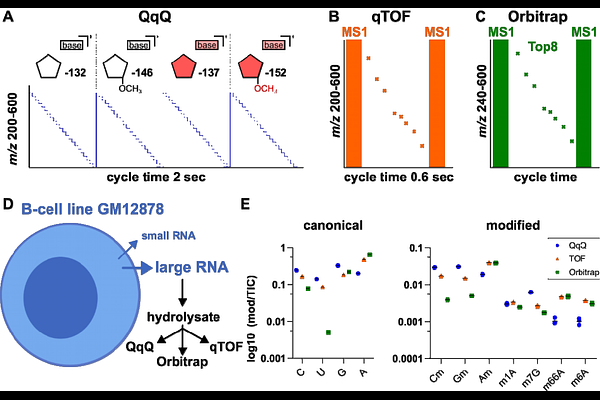
AbstractRNA modification analysis by LC-MS/MS is central to epitranscriptomics, yet quantitative comparison across laboratories and instrument platforms remains poorly standardized. Here, we performed a community-driven benchmarking study during the first Human RNome Pro-ject workshop to systematically evaluate cross-platform reproducibility of ribonucleoside mass spectrometry workflows. Using the same analytical column and gradient, standardized RNA samples, and shared reagents, we compared nucleoside quantification across quadru-pole, time-of-flight, and orbitrap-based LC-MS platforms employing distinct acquisition strategies. While chromatographic separation was highly reproducible across systems, nucleoside-specific MS response behavior differed substantially between platforms and limited direct comparability of relative signal intensities. These response differences varied across ana-lytes and concentration ranges, demonstrating that harmonized chromatography alone is in-sufficient for transferable quantitative analysis. Stable isotope-labeled internal standard (SILIS) normalization substantially reduced platform- and method-dependent response and im-proved agreement for most evaluated modifications. External calibration improved agreement between qTOF and Orbitrap workflows for a subset of modifications but did not fully resolve residual intersystem differences. Based on these findings, we establish benchmark-derived recommendations for harmonized relative and absolute RNA modification quantification, including guidance for calibration de-sign, quality control, and data reporting. Together, this work provides a methodological framework for reproducible nucleoside LC-MS/MS workflows and establishes a foundation for large-scale comparative epitranscriptomic studies.