Small-scale within-drainage spawning behavior causes population differentiation in Atlantic salmon

Small-scale within-drainage spawning behavior causes population differentiation in Atlantic salmon
Di Giorgio, F.; Oliveira Carvalho, C.; Sjöstedt, J.; Lind, M. I.; Gollnisch, R.; Persson, A.; Calles, O.; Shry, S.; Nilsson, P. A.
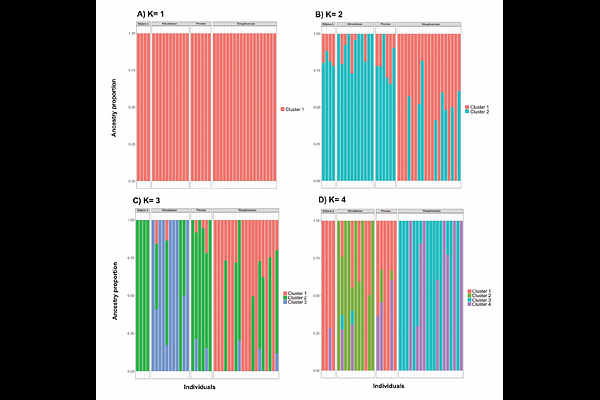
AbstractUnderstanding the genetic structure of keystone species within river networks is essential for effective conservation and management. While population differentiation of anadromous species often occurs between river systems, less research has been conducted on differentiation within rivers with smaller catchment areas. In this study, we investigated the population genetic structure of wild Atlantic salmon (Salmo salar) across the small-scale river Ronne [a] system in southernmost Sweden using Restriction-site Associated DNA sequencing (RADseq). Although the Admixture analysis did not detect clearly defined genetic clusters, significant pairwise FST values and DAPC revealed emerging population differentiation among the Ronne [a] tributaries. The observed patterns are consistent with a system characterized by connectivity, where genetic flow is present but can be reduced by behavioral and ecological factors such as spawning homing behavior and selective movements. These findings suggest that, despite overall connectivity, Atlantic salmon populations in the Ronne [a] catchment area may function as partially independent sub-populations. This highlights the importance of conservation and management strategies in fragmented river systems to consider population genetic structure to support resilient salmon populations under ongoing anthropogenic pressures.