AGN Disks as Supernova Mufflers I: 3D Local Hydrodynamic Models

AGN Disks as Supernova Mufflers I: 3D Local Hydrodynamic Models
Harrison E. Cook, Wladimir Lyra, Mordecai-Mark Mac Low, K. E. Saavik Ford, Barry McKernan
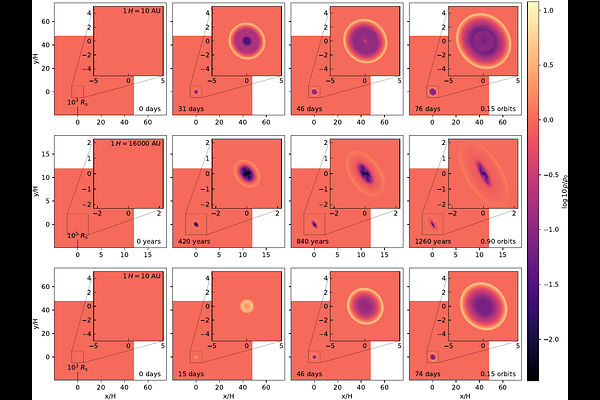
AbstractSupernova (SN) shocks that originate from stars on orbits embedded in dense active galactic nuclei (AGN) accretion disks evolve differently from those that occur in the interstellar medium. We aim to assess how shocks evolve in this dense stratified medium and understand where SNe are muffled and have their kinetic energy absorbed by an AGN disk versus escaping. We use Sirko \& Goodman (SG) and Thompson, Quataert \& Murray (TQM) AGN disk models for midplane radial profiles, generated with the pAGN code; we compare the disk pressure to the energy of a standard core-collapse SN ($10^{51}\,{\rm erg}$) to find radii where shock breakout can occur. For verification, we evolve three-dimensional hydrodynamic shearing box simulations of stratified Gaussian disks constructed from the midplane values that are injected with energy and mass from SNe placed at multiple radii and vertical locations, using the Athena code. We find SN shocks in SG disks around black holes with mass $\Mbh=10^6\,\Msun$ become muffled beyond $R\sim10^6\,\Rs$, and that this muffling radius is inversely proportional to supermassive black hole (SMBH) mass with muffling occurring at $R\sim10^2\,\Rs$ for $\Mbh=10^9\,\Msun$. Around TQM disks, the muffling radius occurs at $R\sim10^6\,\Rs$, independent of $\Mbh$. The largest determining factor for muffling a SN shock is the local scale height of the AGN disk. In conclusion, we developed a predictive analytic criterion to identify where AGN disks can muffle SNe shocks depending on their density and vertical scale.