Long-Range Coupling of Posterior Cell Addition and Anterior Vacuolation Provides Robustness in Notochord Elongation.

Long-Range Coupling of Posterior Cell Addition and Anterior Vacuolation Provides Robustness in Notochord Elongation.
Camacho de la Macorra, C.; Ceccarelli, A.; Saunders, D.; Chara, O.; Serrano Najera, G.; Steventon, B.
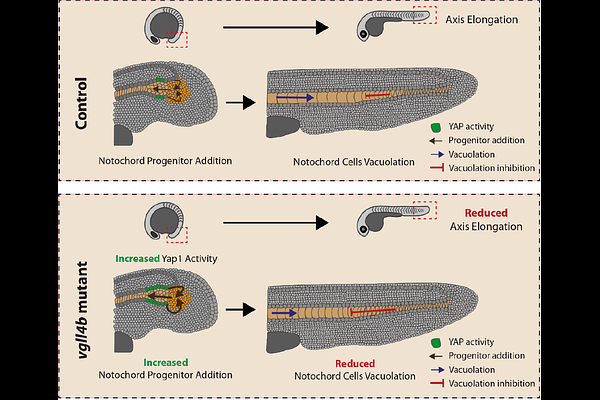
AbstractRobust tissue growth control requires long-range communication between the rate of progenitor addition and tissue expansion. However, the regulatory mechanisms that couple these two processes are unknown. In zebrafish, notochord morphogenesis is a principal driver of axis extension through the combined actions of posterior progenitor addition and anterior vacuolation. To elucidate how progenitor dynamics and vacuole-driven cell expansion interact to shape notochord development, we first generated a mathematical model that links progenitor addition rate to the progressive expansion of cells from anterior-to-posterior to simulate vacuolation rate. Comparing this with empirical measurements, we find that progenitor incorporation together with vacuolation, produces a linear gradient in nearest neighbour distance. We next explored the role of YAP/TAZ in regulating the rate of progenitor addition in mutants for YAP/TAZ inhibitor vgll4b. We find that vgll4b expression and YAP activity are enriched in posterior midline progenitors. Loss of vgll4b elevates YAP signaling, enhances progenitor addition, restricts vacuole expansion, and - after a transient buffering phase - compromises A-P axis elongation. These results support a long-range feedback mechanism linking progenitor recruitment to vacuolation, enabling the notochord to balance cellular input with volumetric expansion, thereby maintaining tissue proportions.