Reliability-weighted target prioritization in CD4+ T-cell Perturb-seq: a generalizability-theory decomposition

Reliability-weighted target prioritization in CD4+ T-cell Perturb-seq: a generalizability-theory decomposition
Cheng, C.
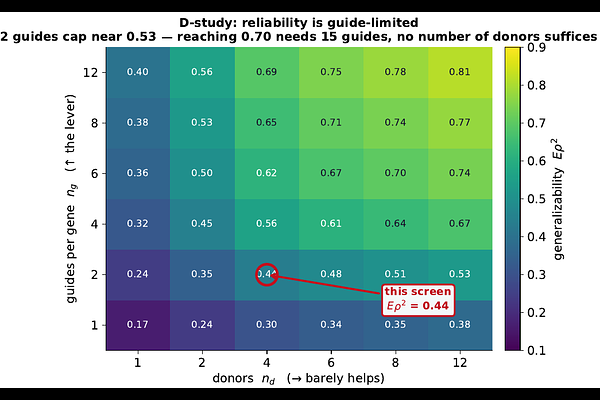
AbstractGenome-scale Perturb-seq screens prioritize candidate targets by the strength of a perturbation's transcriptional effect. Effect strength does not answer a prior measurement question: is the readout dependable? A large effect estimated from a single guide, a single donor, or a pseudobulk of few cells need not survive replication, and for target prioritization each false lead costs a validation experiment. We treat each perturbation effect as a measurement in a crossed Target x Guide x Donor x Condition design and apply generalizability theory (Cronbach et al., 1972; Brennan, 2001) to separate the dependable part of an effect from facet-specific idiosyncrasy. Guides and donors enter as random facets; condition enters as a fixed facet and is analyzed within its levels. For each target we report a dependability profile over the facets and a joint generalizability coefficient over the two random facets, and we re-rank targets by effect magnitude weighted by that coefficient. On the released screen (Zhu et al., 2025), removing the measurement-error floor estimated from the non-targeting controls raises the number of genes with a dependable target-signal share above .10 from 40 to 7,674. Analyzed within activation states, dependability recovers the T-cell-receptor signaling module as reliably measurable only in activated cells, without recourse to gene annotation. A design study indicates that reliability is limited by the number of guides rather than the number of donors, so a future screen should add guides. Every methodological decision was recorded and adversarially reviewed, and all results regenerate from the released summary statistics.