CellSwarm: LLM-Driven Cell Agents Recapitulate Tumor Microenvironment Dynamics and Sense Indirect Genetic Perturbations

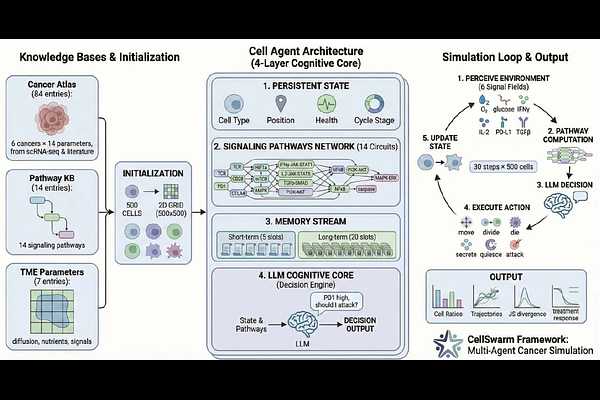
CellSwarm: LLM-Driven Cell Agents Recapitulate Tumor Microenvironment Dynamics and Sense Indirect Genetic Perturbations
Meng, X.; Wang, T.; Dong, Z.; Li, X.; Cui, X.; Wang, L.
AbstractAgent-based models of the tumor microenvironment (TME) traditionally rely on hand-coded rules that cannot generalize beyond their programmed logic. Here we present CellSwarm, a framework that replaces rule-based cell decision-making with large language model (LLM)-driven autonomous agents. Each simulated cell maintains persistent state, 14 signal pathways, and a memory stream, with an LLM serving as its cognitive core. Using structured knowledge bases for cancer-specific context, CellSwarm recapitulates TNBC microenvironment composition with fidelity comparable to hand-coded rules (Jensen-Shannon divergence 0.144 vs. 0.146; P = 0.012 vs. random, Mann-Whitney U test). Beyond matching rule-based performance, LLM-driven agents demonstrate three capabilities absent from rule-based models: cross-cancer generalization by swapping knowledge base entries, treatment response prediction concordant with clinical data (anti-PD-1: 17.6% simulated vs. 21% clinical), and sensing of indirect genetic perturbations that propagate through intermediate signaling cascades (IFN-gamma KO: Agent +15.7% vs. Rules +0.3%; P = 0.005). CellSwarm demonstrates that LLM-driven cell agents can recapitulate and extend TME simulation beyond the reach of hand-coded rules.