An Intermediate Mesoderm Premyogenic Niche Supports Early Human Myogenic Lineage Progression

An Intermediate Mesoderm Premyogenic Niche Supports Early Human Myogenic Lineage Progression
Jaime, O. G.; Bazan, K. F.; Li, A.; Deai, A. A.; Lakatos, A.; Hicks, M. R.
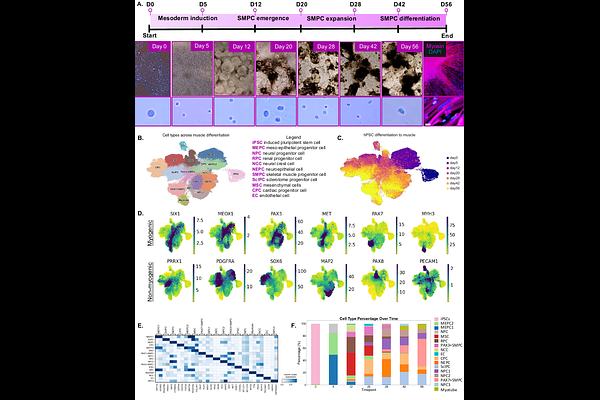
AbstractTransient cell states that precede and support human myogenic lineage commitment, and the intrinsic and extrinsic signals that control them, remain poorly defined in vitro. Here, we used longitudinal single-nucleus profiling, together with a SIX1:H2B-GFP hPSC reporter for lineage tracing, resolved previously uncaptured transient intermediates and sequential waves of human myogenesis across differentiation and in vivo. We show that hPSC-directed myogenesis gives rise in parallel to paraxial mesoderm and a transient PAX8+ intermediate mesoderm population that forms a 3-dimensional pre-myogenic niche supporting the PAX3-to-PAX7 myogenic progenitor transition. LIANA+ analysis further identified a temporally restricted BMP7-BMPR1B interaction, together with laminin-linked signaling, between PAX8+ niche cells and skeletal muscle progenitors before commitment. We further show that dynamic SIX1 cofactor switching, including EYA3 activity, is required for PAX3-to-PAX7 progression, and that disruption of this program compromises multi-lineage niche integrity. Together, these findings define how transient niche populations and intrinsic regulatory networks coordinate early human myogenic lineage progression and provide a human in vitro platform to study parallel intermediate and paraxial mesoderm development during myogenesis.