Determinants of metal import and specificity in a bacterial transporter

Determinants of metal import and specificity in a bacterial transporter
Berry, S. P.; Freedman, C. B.; Marks, D. S.; Gaudet, R.
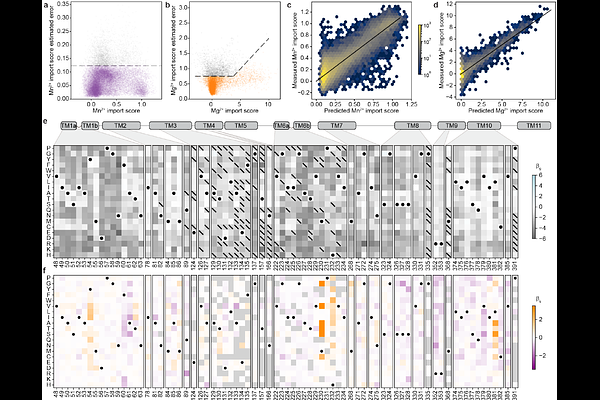
AbstractMembrane transporters have evolved finely tuned substrate specificity within a limited repertoire of structural superfamilies, but the biophysical origins of transporter specificity remain unclear. We have systematically investigated the determinants of import and specificity in the model Deinococcus radiodurans (Dra)Nramp metal importer by testing targeted structure- and evolution-guided libraries of sequence variants in new high-throughput assays for import of the native substrate Mn2+ and the chemically similar but excluded metal Mg2+. The effects of most combinatorial mutations on Mn2+ import fit a simple global epistasis model, but many additional unexplained long-range epistatic interactions cluster at a set of structural hotspots at the inner and outer vestibules of the transporter. By contrast, mutations enabling Mg2+ import have non-additive effects and generally fall into two categories: a few core specificity positions in the first two shells around the metal are sufficient to allow DraNramp to import Mg2+, and additional modulator mutations can finetune specificity when combined with core-position mutations. The modulator mutations overlap considerably with key epistatic mutations, and we use this insight to propose a new biochemical model for how mutations that alter conformational balance in transporters can lead both to long-range epistasis and specificity modulation.