Surface electrostatic networks control hydrophobic core remodeling in a pH-dependent switching protein

Surface electrostatic networks control hydrophobic core remodeling in a pH-dependent switching protein
McDonald, I. M.; Socas, L. B.; Walton-Raaby, M.; Liu, X.; Dasari, S.; Emmanuel, B. G.; Butt, M. S.; Kalyaanamoorthy, S.; Brooks, C. L.; Meiering, E. M.
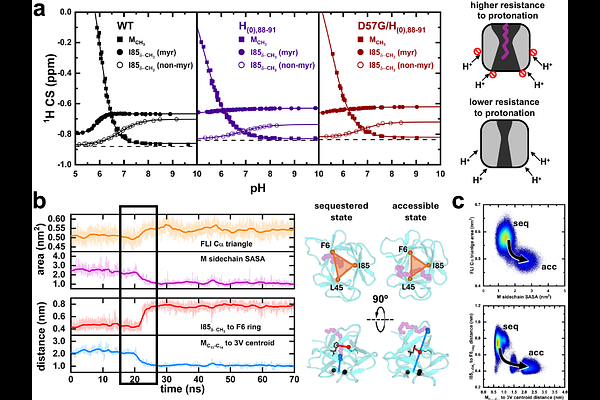
AbstractCommunication between protein surfaces and their buried cores is central to protein structure and function, yet this phenomenon remains challenging to predict and control at high resolution. Changes in the protonation of surface ionizable residues communicate with the hydrophobic core, for example, in diverse pH-dependent protein functions. Hisactophilin, a histidine-rich actin- and membrane-binding protein, provides a general model for exploring such communication as it exhibits a finely tuned pH-regulated myristoyl-switching function. Upon reversible proton binding, the myristoyl group shifts between being sequestered in the hydrophobic core and more solvent accessible. In the current study we utilize experimental and computational approaches we uncover how binding of ~1.5 net protons alters electrostatic interactions involving ionizable residues distributed across much of the protein surface. These changes are transmitted to the hydrophobic core through dynamic communities of ionizable and hydrophobic residues which substantially rearrange upon switching. The effects of mutating individual ionizable residues are weaker than those of core hydrophobic residues, and only combined mutation of multiple ionizable residues caused substantial functional change. Together, these results reveal how communication between surface ionizable residues and the hydrophobic core is mediated by extensive interaction networks that reorganize in response to changes in protonation. These results may provide general insights for understanding protein cooperativity and the coupling of surface and core residues in protein function, disease, evolution, engineering, and design.