Division of Synthetic Cells Using a Genomically Encoded One-Protein Divisome

Division of Synthetic Cells Using a Genomically Encoded One-Protein Divisome
Sharma, C.; Nafar, N.; Kerssemakers, J.; Gutierrez, J. F.; Koenderink, G. H.; Dekker, C.
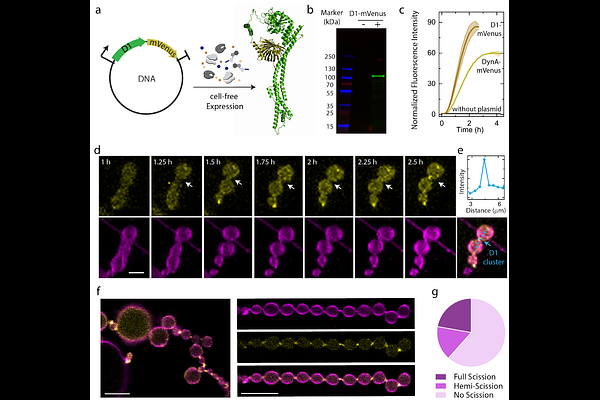
AbstractSynthetic biology is emerging as a powerful tool to understand life by building minimal synthetic cells whose functions are encoded within their genome. An essential function of cells is abscission, the final step of cell division that breaks the last connection between two emerging daughter cells. Abscission is challenging to reconstitute as it is energetically unfavorable to rearrange the cell membrane. Here, we demonstrate a minimal one-component abscission machinery for synthetic cells using the bacterial protein dynamin A (DynA), which is uniquely capable of driving scission inside membrane necks. Cell-free expression of this synthetic cell module is complicated by the large size of DynA (137 kDa) and the presence of a hydrophobic lipid-binding loop within its structure. We overcome these challenges by expressing DynA inside lipid vesicles with a high fraction of negatively charged lipids. We find that DynA enriches at the bridges of dumbbell-shaped vesicles, where it drives membrane scission and full division. The ability to monitor DynA dynamics through genomic encoding further provides hints about the mechanism of abscission including cooperative enrichment at the necks and constriction of the necks. Finally, we demonstrate that the smaller (71 kDa) dynamin D1 domain alone exerts the same function, which is beneficial for future integration with other synthetic cell modules since its much smaller gene size reduces the burden on the synthetic genome. This autonomously operating abscission machinery presents the first example of a self-dividing synthetic cell, marking an important step towards constructing a synthetic cell that is able to sustainably replicate.