Prospect for Detection of Strongly Lensed Multi-messenger Signals of Binary Neutron Star Mergers

Prospect for Detection of Strongly Lensed Multi-messenger Signals of Binary Neutron Star Mergers
Zhiwei Chen, Youjun Lu, Changwen Zeng
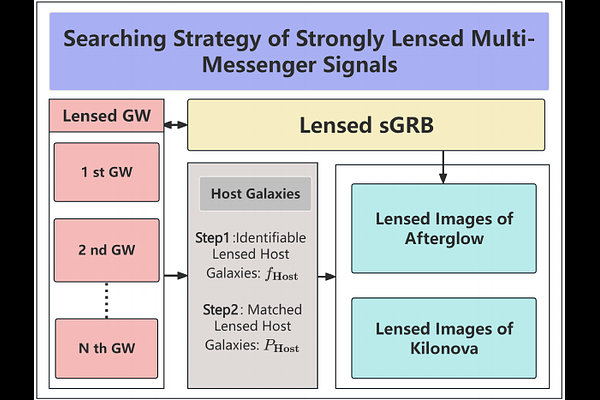
AbstractThe gravitational lensing of multi-messenger signals from binary neutron star mergers (BNSs), including gravitational waves (GWs), short Gamma-Ray bursts (sGRBs), kilonovae, and afterglows, can serve as a unique probe to constrain the mass of the graviton and cosmological parameters. In this paper, we estimate the detection rates of lensed electromagnetic counterparts associated with lensed BNS GW events detected by Cosmic Explorer and Einstein Telescope. For kilonovae and afterglows, we further consider a complementary pointed follow-up strategy targeting pre-identified galaxy-scale lens candidates within the GW localization region. By utilizing both numerical and observational constraints on BNS mergers, we find that: (1) Future $γ$-ray telescopes, even with a sensitivity more than ten times better than that of Fermi-GBM, may only detect lensed sGRB prompt emission at a rate $\sim 0.1$ yr$^{-1}$, corresponding to $\sim 2\times 10^{-3}$ of detectable lensed BNS GW events. (2) For the known-lens pointed strategy, the identifiable lensed-host fraction is approximately $0.15-0.30$ for the fiducial deep lens-catalog case considered, suggesting a possible gain in per-lens sensitivity for faint kilonovae and afterglows. (3) An RST-like near-infrared facility could detect lensed kilonovae at rates of approximately $\sim 0.45^{+0.81}_{-0.34}$, $0.55^{+0.98}_{-0.41}$, and $0.078^{+0.139}_{-0.059}$ yr$^{-1}$ in the F106, F158, and F213 bands, respectively. (4) Lensed afterglows remain difficult to detect in the optical and radio bands, while ATHENA-like X-ray observations may detect $0.5-5$ events over ten years.