Lipid droplet shape and tendency towards budding: insight from theory and molecular simulations

Lipid droplet shape and tendency towards budding: insight from theory and molecular simulations
Nieto, V.; Crowley, J. L.; Deslandes, F.; Thiam, A. R.; Foret, L.; Monticelli, L.
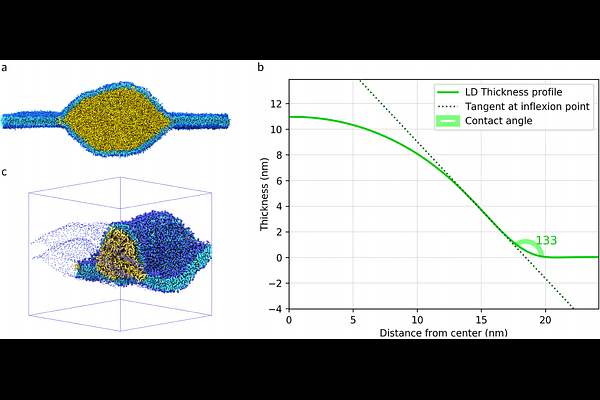
AbstractLipid droplets (LDs) are cellular organelles responsible for lipid storage and metabolism. They resemble oil-in-water emulsions, coated with a monolayer of phospholipids and proteins. The mechanism of biogenesis of LDs is not fully understood, but it is well established that it involves phase separation of oil (consisting of neutral lipids, such as triglycerides) from the surrounding phospholipids, which generates oil lenses embedded in lipid bilayers, also known as nascent LDs. As nascent LDs grow, at some point they bud out of the bilayer membrane, forming nearly spherical droplets. Nascent LDs have different propensity to bud, and it has been proposed that their shape provides information on such propensity to bud; however, LD shape is difficult to determine experimentally. Here we studied the shape of lipid droplets using MD simulations at the coarse-grained level, and compared it to the predictions by an established theory. Our general system setup features an oil lens embedded into a flat, periodic bilayer. We found that the shape of simulated nascent LDs resembles a spherical cap (i.e., it has constant curvature over most of the surface), in excellent agreement with the theory, already for very small droplet sizes. The aspect ratio (height/radius) of nascent LDs increased with increasing LD volume, increasing membrane softness, and increasing surface tension between oil and water, also in agreement with theoretical predictions; however, it remained lower than 1 (i.e., the ratio for a sphere) for LDs of up to 40 nm in diameter. Fitting the simulated LD shapes with a theoretical shape equation suggests that a non-zero surface tension is present in both the monolayer and in the bilayer region, consistent with the flattened shape. The existence of a relatively high surface tension in the bilayer region was confirmed by local stress calculations, and indicates that the periodic system setup does not reproduce the properties of nascent LDs in the ER, where the bilayer tension is two orders of magnitude lower. However, the simulations provide a microscopic view into the properties of droplet embedded vesicles.