Frozen Protein Foundation-Model Embeddings Improve Antibody-Antigen ΔΔG Ranking

Frozen Protein Foundation-Model Embeddings Improve Antibody-Antigen ΔΔG Ranking
Wang, R.; Jin, K.; Pan, L.
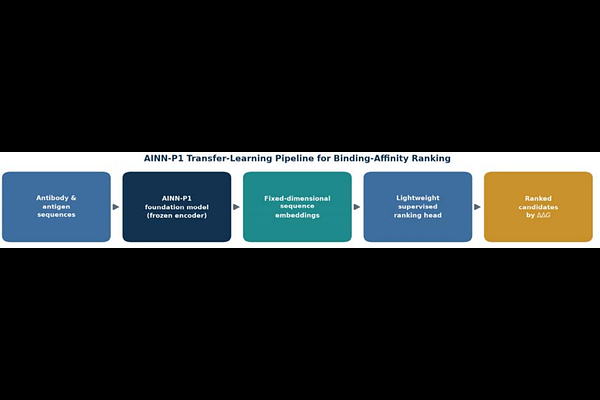
AbstractWe investigate whether representations from AINN-P1--a protein foundation model trained autoregressively on tens of millions of natural protein sequences--transfer to the task of ranking antibody-antigen pairs by binding affinity. Casting affinity maturation as a learning-to-rank problem over the change in binding free energy ({Delta}{Delta}G), we compare a task-specific sequence model trained end-to-end from scratch against lightweight downstream heads built on top of frozen AINN-P1 embeddings, all evaluated under an identical five-fold cross-validation protocol. A regularized linear probe on the frozen embeddings already surpasses the from-scratch baseline, and an optimized lightweight head raises the mean Spearman rank correlation from 0.42 to 0.53--a relative improvement of approximately 28%--while training in seconds and without any fine-tuning of the foundation model. Because a linear probe alone exceeds the fully trained end-to-end baseline, the gain is attributable to representation quality rather than to added downstream-model capacity. These results position frozen foundation-model embeddings as a strong, data-efficient default for affinity ranking in antibody engineering and establish a conservative lower bound that task-adaptive fine-tuning is expected to exceed.