A CRISPR/Cas9-induced blunt-end telomere system in S. pombe reveals RNase H2-dependent RNA primer removal at the terminal Okazaki fragment of lagging telomeres

A CRISPR/Cas9-induced blunt-end telomere system in S. pombe reveals RNase H2-dependent RNA primer removal at the terminal Okazaki fragment of lagging telomeres
Zou, S.; Ye, T.; Fu, L.; Zhou, J.-Q.
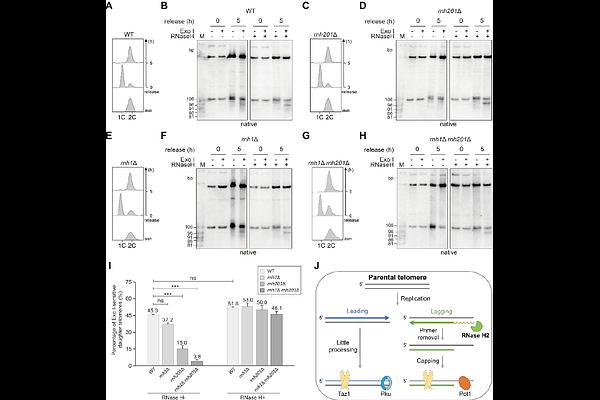
AbstractStudying the fine-scale dynamics of telomere replication has been hindered by the heterogeneity of native telomeres and the limitations of existing tools. Here, we report a highly efficient and inducible CRISPR/Cas9-mediated system for generating de novo telomeres with defined blunt ends in S. pombe. This fine setting allows for the precise dissection of post-replicative telomere end structures at near single-nucleotide resolution. Using this system, we show that the replicated leading-strand telomere is blunt-ended, while the lagging-strand counterpart contains a ~10-nt 3' overhang resulting from RNA primer removal. By analyzing mutants deficient in ribonucleases, we found that the removal of this terminal RNA primer is specifically dependent on RNase H2, but not RNase H1. This RNase H2-dependent mechanism is essential for defining the mature structure of the lagging-strand telomere with authentic telomeric sequences. Our findings reveal a fundamental asymmetry in telomere end processing after replication and establish RNase H2 as the key enzyme responsible for resolving the terminal RNA primer in lagging-strand telomeres. This mechanism, conserved from budding to fission yeast, underscores the critical and evolutionarily ancient role of RNase H2 in defining eukaryotic telomere architecture.