Open Digital Bioassays Enabled by Aqueous Two-Phase Microreactor Arrays

Open Digital Bioassays Enabled by Aqueous Two-Phase Microreactor Arrays
Minagawa, Y.; Matsumoto, K.; Nakata, S.; Isago, H.; Nangaku, M.; Kurano, M.; Noji, H.
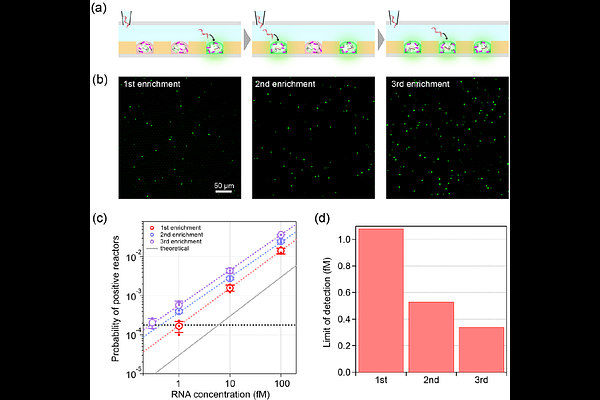
AbstractDigital bioassays enable precise single-molecule quantification but are difficult to adapt to point-of-care testing (POCT) because conventional protocols include off-chip complex processes for sample treatment and sealing, requiring hardware and workflow complexity. We present OASSIS (Open Aqueous two-phase Separation System for Integrated Single- molecule digital bioassay platform), an oil-free and open ATPS platform that localizes both targets and signals in femtoliter-scale dextran (DEX) droplets beneath a polyethylene glycol (PEG) phase. We integrated a CRISPR-Cas13a assay system with a novel, branched fluorescent reporter conjugated to a dextran-binding domain (DBD), which ensures signal retention within the DEX droplets after cleavage. Fluorescence recovery after photobleaching experiments confirmed this robust signal confinement. OASSIS not only performs amplification-free digital RNA detection but also enables serial sample introductions through its open-format architecture that progressively improve sensitivity: the limit of detection (LOD) improved from 1.08 fM (first introduction) to 0.34 fM (third introduction). Furthermore, OASSIS demonstrated specific detection and ~10-fold enrichment from a complex, denaturant-treated nasopharyngeal swab matrix. Together, these results demonstrate that the open-format architecture of OASSIS provides a practical route toward sensitive, low-complexity POCT and clinical diagnostic applications.