Influence of Lipomannan and Lipoarabinomannan Concentration on Mycobacterial Inner Membranes Characterized by All-atom Simulations

Influence of Lipomannan and Lipoarabinomannan Concentration on Mycobacterial Inner Membranes Characterized by All-atom Simulations
Lee, H.; Rygh, N.; Chavent, M.; Im, W.
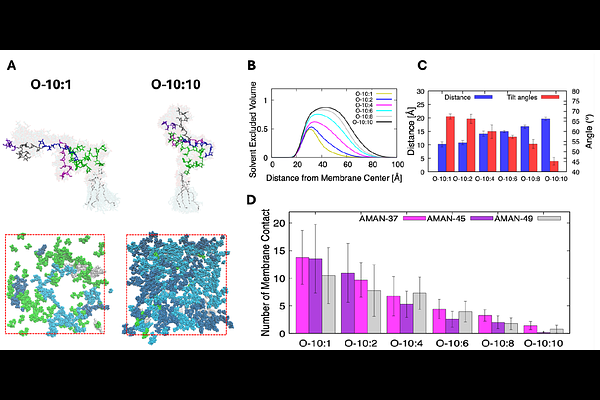
AbstractMycobacteria are responsible for causing severe illnesses like tuberculosis and leprosy in humans. Studying the mycobacteria cell envelope presents a significant challenge due to its intricate lipid compositions and structural variations and also its harmful nature in a typical experiment setting. In this study, we use all-atom molecular dynamics simulation to study mycobacterial inner membranes (MIMs). By incorporating different types of phosphatidyl-myo-inositol-mannosides (PIMs) and their glycoconjugates such as lipomannans (LM) and lipoarabinomannans (LAM) lipoglycans, we have constructed both symmetric and asymmetric membrane systems to study the MIM structure and dynamics under varying compositions of each lipid type. Our results show that the phospholipid/PIM-rich inner leaflet remains a stable, fluid bilayer, and the outer leaflet structure and dynamics are heavily governed by lipoglycan surface density. Importantly, as LM/LAM concentration increases, the polysaccharide chains shift from flexible, membrane-lying orientations to a compact brush-like state aligned with the membrane normal. This crowding significantly reduces the solvent-accessible volume and limits direct interactions between LM/LAM sugars and the outer leaflet surface. Furthermore, we observe that high lipoglycan presence in the outer leaflet slows lipid diffusion across the entire bilayer, demonstrating a dynamic coupling between the two leaflets. By resolving these LM/LAM sugar-level dynamics and their impact on membrane-wide properties, this study provides a molecular framework for future MIM modeling and simulation with various (peripheral) membrane proteins to better understand how the MIM functions as a regulated physical barrier and a platform for mycobacterial virulence.