Environment-dependent landscapes of coding variant impacts on coproporphyrinogen oxidase

Environment-dependent landscapes of coding variant impacts on coproporphyrinogen oxidase
van Loggerenberg, W.; Zhang, H.; Senguttuvan, V.; Chambers, M. J.; Panchalingam, M.; Rasoulzadeh, A.; Axakova, A.; Gebbia, M.; Desnick, R. J.; Wang, B.; Schmitt, C.; Gouya, L.; To-Figueras, J.; Wahl, A.; Bahar, I.; Doruker, P.; Roth, F. P.
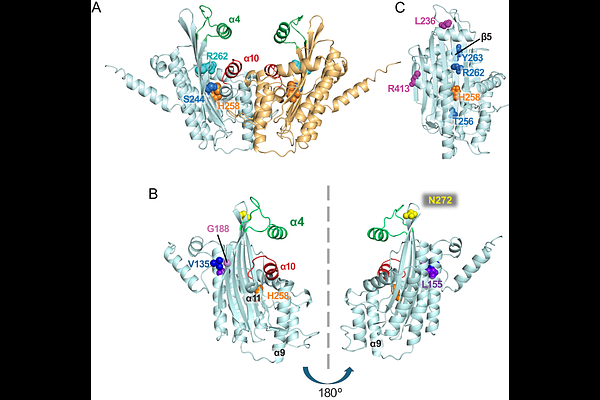
AbstractHereditary coproporphyria (HCP) -- caused by variants in coproporphyrinogen oxidase (CPOX) -- can be diagnosed via genome sequencing. However, 74% of clinically-reported CPOX missense variants are classified as variants of uncertain significance (VUS) due to lack of evidence. CPOX variant classification is further complicated by environment-dependence: For example, the CPOX variant p.Asn272His (c.814A>C) is classified as benign yet has been associated with HCP-like symptoms in the context of mercury exposure. Here we measured the functional impact of nearly all possible CPOX amino acid substitutions in both the presence and absence of mercury. The resulting CPOX variant effect maps reflect known protein structure and mutational tolerance patterns while also offering new sequence-structure-function insights. Scores from this atlas not only distinguish pathogenic from benign variants but also identify mercury-dependent variant impacts, thus informing our clinical, structural, and functional understanding of CPOX deficiency and illustrating the value of systematic context-dependent multiplexed assays of genetic variant effects.