Chromosome organization of Entamoeba histolytica and Entamoeba dispar

Chromosome organization of Entamoeba histolytica and Entamoeba dispar
Kawano-Sugaya, T.; Kobayashi, S.; Kawashima, A.; Saito-Nakano, Y.; Izumiyama, S.; Nozaki, T.; Nakada-Tsukui, K.
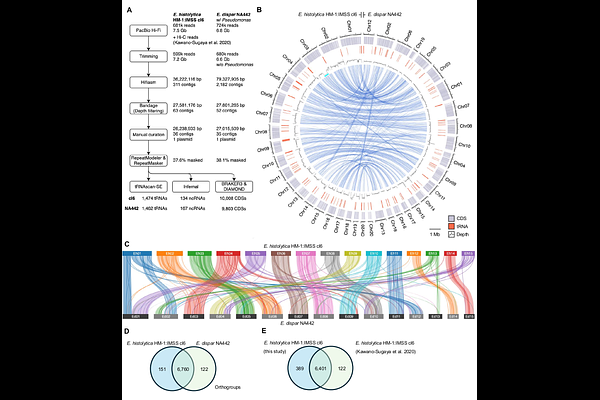
AbstractEntamoeba histolytica is a clinically important pathogenic eukaryote and the causative agent of amoebic dysentery. Entamoeba dispar, a nonpathogenic commensal species that resides in the human colon, is the closest sibling species, and serves as an appropriate comparator for genome-wide analysis. Although the genome of E. histolytica is approximately 26.9 Mb, and the largest known genome within the genus, that of E. invadens, is approximately 40.9 Mb, obtaining high-quality assemblies in this genus has remained challenging due to extensive repetitive regions, tRNA gene arrays, and aneuploidy. Here, we used PacBio HiFi sequencing to assemble the genomes of the pathogenic E. histolytica and the nonpathogenic E. dispar. We reconstructed all 36 chromosomes of E. histolytica and 35 chromosomes of E. dispar, assembling each as a single continuous DNA sequence (contig). The two species exhibited high genome-wide nucleotide similarity and conserved synteny at the amino acid level. At one end of each chromosome, we identified tRNA arrays, whereas the opposite end lacked such arrays, resulting in an asymmetric chromosomal architecture. Analysis of unique-read depth revealed widespread aneuploidy in both species: E. histolytica is predominantly tetraploid, whereas E. dispar is diploid, a conclusion further supported by SNP allele-frequency distributions. These assemblies provide a robust foundation for comparative genomics in Entamoeba and offer detailed insights into chromosome-end structure and ploidy.