LOFAR constraints on the repetition & environments of CHIME FRBs

LOFAR constraints on the repetition & environments of CHIME FRBs
Pragya Chawla, Akshatha Gopinath, Ninisha Manaswini, Cees Bassa, Jason Hessels, Vlad Kondratiev, Daniele Michilli, Ziggy Pleunis
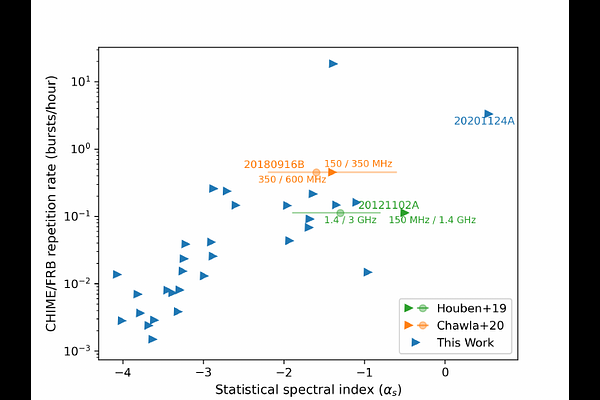
AbstractThe behaviour of fast radio bursts (FRBs) at radio frequencies <400 MHz is not well understood due to very few detections, with only two known sources detected below 300 MHz. Characterising low-frequency emission of FRBs is vital for understanding FRB emission mechanisms and circumburst environments. We robustly characterise the 150 MHz activity CHIME-detected FRB sources relative to their 600 MHz activity -- using their non-detection in 473 h of archival observations from the Low Frequency Array (LOFAR) Tied-Array All-Sky Survey (LOTAAS), and 252 h of LOFAR observations of 14 repeating FRB sources, the largest sub-300 MHz targeted FRB campaign to date. In the LOTAAS data, we search for repeat bursts from 33 CHIME/FRB repeaters, 10 candidate repeaters and 430 apparent non-repeaters. Their non-detection yields a population-level constraint on the statistical spectral index $\alpha_{s, 150MHz/600MHz}>-0.9$, indicating that FRB spectral indices are, on average, flatter than known spectral indices from pulsars. From the targeted campaign, we find that the prolific repeater FRB 20201124A shows a positive $\alpha_s>0.55$, implying reduced low-frequency activity, unlike the typically negative $\alpha_{s}$ seen from FRBs at higher frequency bands. We explore free-free absorption in the circumburst environment as a cause of the non-detection at 150 MHz. The non-detection of FRB 20201124A is consistent with either a very young $\sim10$ yr old supernova remnant, or a typical HII region. Our simulations indicate that LOFAR2.0 can detect 0.3-9 FRBs per week, and up to 4 FRBs at redshifts in the range $1<z<3$. Such detections will provide robust constraints on cosmological parameters due to their clean environments. Our results guide future low-frequency FRB searches by showing how even non-detections can place meaningful constraints on the repetition rates and circumburst environments of FRBs.