Power is a major confounder in the analysis of cross-ancestry 'portability' in human eQTLs

Power is a major confounder in the analysis of cross-ancestry 'portability' in human eQTLs
Gibbs, P. M.; Beasley, I. J.; Del Azodi, C. B.; McCarthy, D. J.; Gallego Romero, I.
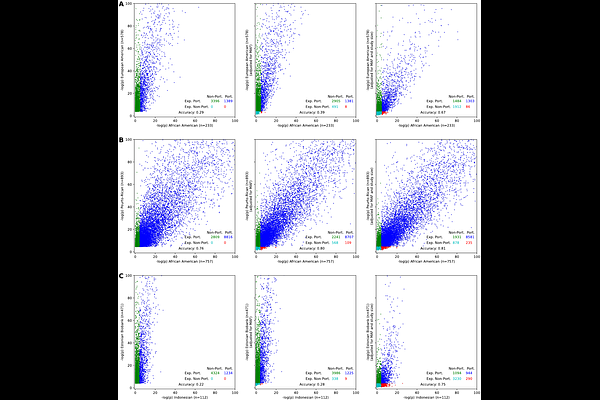
AbstractThe phenotypic effects of germline variants are often mediated through gene regulation. Expression quantitative trait loci (eQTLs) are genetic variants associated with changes in gene expression. Understanding how eQTLs vary across populations is essential for characterising the genetic and regulatory drivers of trait diversity. Meta-analysing eQTL studies from multiple populations enables more robust detection of eQTLs and can reveal regulatory mechanisms shaped by population-specific environmental or ancestry-related factors. However, across the multi-ancestry eQTL literature, a wide range of methods have been used to quantify eQTL portability across ancestry groups. Because different studies employ different portability metrics, it is challenging to form a coherent view of the regulatory landscape across populations. In this work, we analyse eQTL summary statistics from ten datasets matched on tissue type and sequencing technology. We compare portability metrics used previously and show that they can yield markedly different patterns of apparent regulatory conservation or divergence. We then examine the statistical determinants of portability across metrics and demonstrate that sample size, minor allele frequency, and linkage disequilibrium are major drivers of the observed differences in eQTL portability across studies. These findings highlight that differences in statistical power stemming from factors such as population size and allele frequency must be accounted for when evaluating eQTL portability. To address this issue, we introduce a new approach designed to correct for these factors when calling eQTL portability. Finally, we show that empirical Bayes multivariate adaptive shrinkage provides a powerful framework for meta-analysing multiple eQTL studies, with the ability to pool signals across populations to produce more robust effect-size estimates within each population.