Low Depth Unitary Coupled Cluster Algorithm for Large Chemical Systems

Low Depth Unitary Coupled Cluster Algorithm for Large Chemical Systems
Jeremy Canfield, Dominika Zgid, J K Freericks
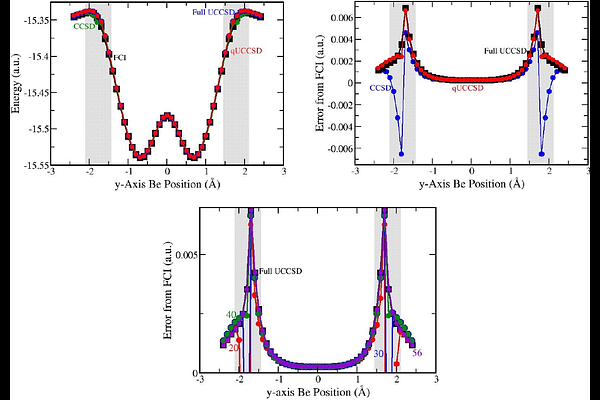
AbstractThe unitary coupled cluster (UCC) algorithm is one of the most promising implementations of the variational quantum eigensolver for quantum computers. However, for large systems, the number of UCC factors leads to deep quantum circuits, which are prohibitive for execution on quantum hardware. To address this, circuit depth can be reduced at the cost of more measurements with a Taylor series expansion of UCC factors with small angles, while treating the large-angle factors exactly. We implement this approach to quadratic order (qUCC) for systems with strong correlations and systems where conventional methods like coupled cluster (CC) with low excitation levels fail, but UCC and qUCC perform well. We study hydrogen chains and the BeH2 molecule that allow us to change the degree of strong correlation due to geometrical distortions. We show, via a dramatic increase in number of factors able to handle exactly, a systematic convergence of these results as more exact UCC factors are included in the calculations -- the hardest to converge regime is in the crossover from weak to strong coupling. In all cases the total number of UCC factors needed to be treated exactly is much less than the total number of UCC factors available (typically about one-third to one-half of the total number of factors).