Non-LTE Ionization Modeling for Helium and Strontium in Neutron Star Merger Ejecta

Non-LTE Ionization Modeling for Helium and Strontium in Neutron Star Merger Ejecta
Koya Chiba, Masaomi Tanaka, Shinya Wanajo, Sho Fujibayashi, Kyohei Kawaguchi, Kenta Hotokezaka
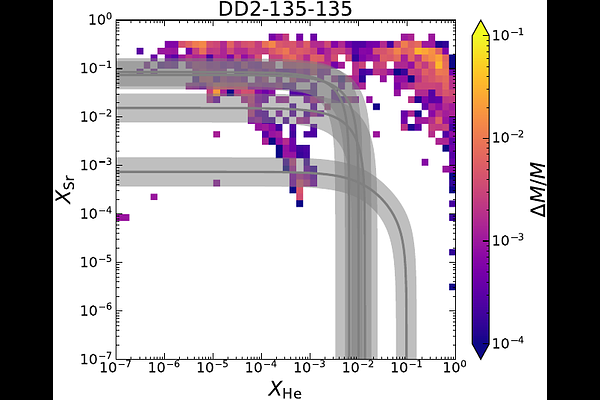
AbstractThe material ejected from a binary neutron star merger produces "kilonova," a radioactively powered emission at ultraviolet, optical, and infrared wavelengths. The early-phase spectra of the kilonova AT2017gfo, following the gravitational wave event GW170817, exhibit a strong absorption feature around $1\,\mathrm{μm}$. Helium (He) and strontium (Sr) have been proposed as the candidate elements contributing to this feature. However, due to the lack of consistent modeling including these two elements simultaneously, the exact contributions of each element to this feature remain unclear. In this study, we develop non-local thermodynamic equilibrium ionization models for He and Sr that take into account ionization by high-energy electrons, and estimate the abundances of each element required to reproduce the observed feature. Our modeling indicates that about $1\, \%$ of He or $1\mathrm{-}10\, \%$ of Sr in mass fraction are present in the ejecta moving at $v \sim 0.15 \, c$. This Sr mass fraction nicely agrees with the mass fraction in the solar $r$-process abundance. Based on comparison with nucleosynthesis calculations, our constraints suggest that $r$-process nucleosynthesis in GW170817 occurs at relatively low electron fraction ($Y_{\rm e} \lesssim 0.35$) and low entropy ($s \lesssim 30 \ k_B/\, \mathrm{nucleon}$) conditions. Interestingly, for $Y_{\rm e}$ $\lesssim 0.15$, the observed feature is reproduced by He with a mass fraction expected from $α$ decays of trans-Pb nuclei, which gives an indirect signature for the production of elements beyond the third $r$-process peak.