Genome-Wide Linkage Disequilibrium, Haplotype Block Structure, and Population Diversity in Nili-Ravi Buffalo (Bubalus bubalis)

Genome-Wide Linkage Disequilibrium, Haplotype Block Structure, and Population Diversity in Nili-Ravi Buffalo (Bubalus bubalis)
Ahmad, A.; mustafa, h.; Khan, W. A.; Manan, A.; Anwer, I.; Akram, W.
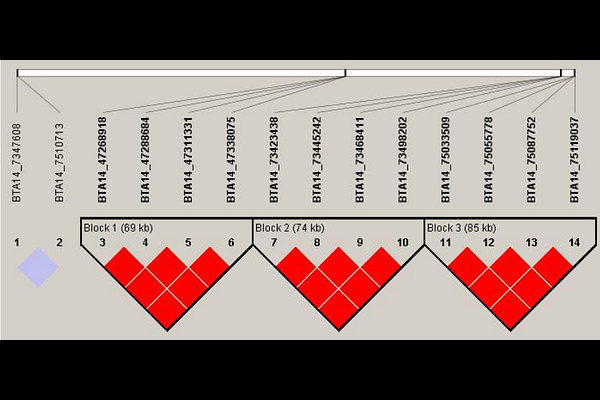
AbstractLinkage disequilibrium (LD) and haplotype block structure govern the resolution and utility of genomic selection, marker-assisted selection, and genome-wide association studies (GWAS) in livestock. We performed a comprehensive genome-wide characterization of LD decay, haplotype block architecture, and population diversity across all 24 autosomes in Nili-Ravi buffalo (Bubalus bubalis; n = 85), using 43,543 post-quality-control SNPs. Mean genome-wide r2 was 0.124 (median 0.074) and mean D' was 0.540 (median 0.481), with LD half-decay at ~70 kb. A total of 133 haplotype blocks encompassing 721 SNPs were identified (Gabriel et al., 2002). Haploview analysis of nine chromosomes harbouring bTB resistance candidate genes revealed contrasting selection signatures: directional selection at innate immune loci (IFNG, TLR1; H' < 0.55) versus balancing selection at adaptive immune loci (BoLA-DRB3, SP110; H' > 1.0). Critically, BBU15 Block 3 (28.6 kb; OR52E5/NCR1 locus, 47.16 Mb) showed a genome-wide significant integrated haplotype score (iHS; -log10p = 5.408), directly co-localising with the published bTB susceptibility QTL (Bermingham et al., 2014). The TAA haplotype (frequency 53.3%) at this block represents a candidate resistance-associated haplotype for marker-assisted selection. These findings provide essential parameters for SNP panel design and bTB resistance breeding in South Asian buffalo.