Multi-trait Multi-environment Genomic Prediction Strategies for Miscanthus sacchariflorus Populations

Multi-trait Multi-environment Genomic Prediction Strategies for Miscanthus sacchariflorus Populations
Proma, S.; Garcia-Abadillo, J.; Sagae, V. S.; Sacks, E.; Leakey, A. D. B.; Zhao, H.; Ghimire, B. K.; Lipka, A. E.; Njuguna, J. N.; Yu, C. Y.; Seong, E. S.; Yoo, J. H.; Nagano, H.; Anzoua, K. G.; Yamada, T.; Chebukin, P.; Jin, X.; Clark, L. V.; Petersen, K. K.; Peng, J.; Sabitov, A.; Dzyubenko, E.; Dzyubenko, N.; Glowacka, K.; Nascimento, M.; Campana Nascimento, A. C.; Dwiyanti, M. S.; Bagment, L.; Shaik, A.; Jarquin, D.
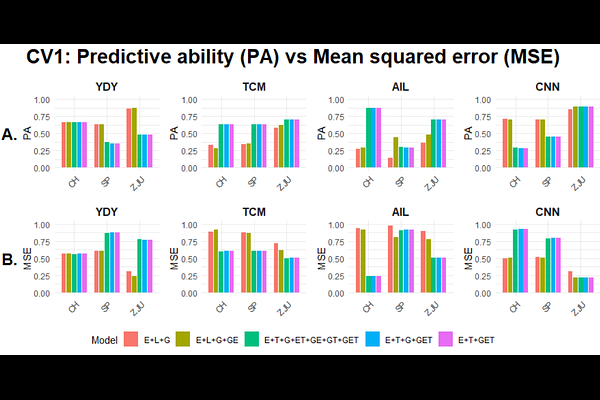
AbstractGenomic selection holds the potential to serve as a strategic tool to enhance the genetic gain of complex traits in Miscanthus breeding programs. The development of improved cultivars requires their assessment for various traits across diverse environments to ensure suitable overall performance. Hence, the multi-trait multi-environment (MTME) genomic prediction (GP) models offer an opportunity to improve selection accuracy. This study aims to evaluate the potential of five GP models: (1) three MTME models including genotype-by-trait-by-environment interaction (GxExT) and (2) two single-trait multi-environment (STME) models (with and without GxE interaction). A Miscanthus sacchariflorus population comprising 336 genotypes evaluated in three environments and scored for four traits (biomass yield YDY, total culm number TCM, average internode length AIL, and culm node number CNN) was analyzed. The predictive ability of the models was evaluated considering three cross-validation schemes resembling realistic scenarios (CV1: predicting new genotypes, CVP: predicting missing traits in a given environment, and CV2: predicting partially observed genotypes). On average, in all cross-validation schemes compared to the STME the predictive ability of the MTME models was 10% to 70% higher for TCM and AIL. On the other hand, for YDY and CNN, both STME models performed similarly or slightly better (between 5 to 64%) than the MTME models in most environments. While the MTME models were not successful for all traits when compared to their STME counterparts, MTME models improved the prediction of the performance of genotypes that were untested across environments or lacked trait information in a specific environment. Overall, our study suggests that MTME GP models can be implemented in Miscanthus breeding programs to improve the predictive ability of the complex traits, shorten breeding cycles, and accelerate selection decisions.