APOBEC3G expression marks a TMB-high, T cell-inflamed tumor state and is associated with response to immune checkpoint blockade in multiple cancer cohorts

APOBEC3G expression marks a TMB-high, T cell-inflamed tumor state and is associated with response to immune checkpoint blockade in multiple cancer cohorts
Butler, K.; Yesudhas, D.; Lone, B.; Banday, A. R.
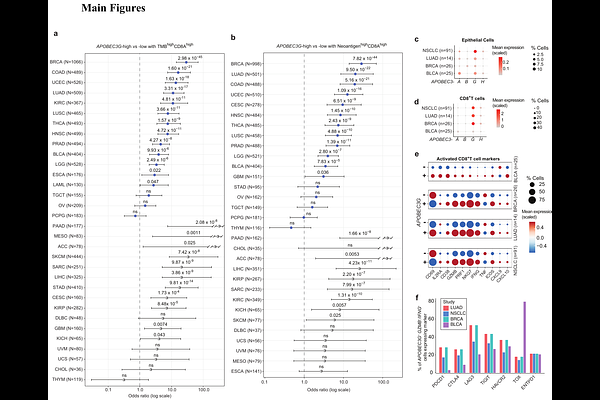
AbstractImmune checkpoint therapies have transformed clinical practice; however, reliable biomarkers to predict response remain limited. Tumor mutational burden (TMB) has emerged as an important biomarker because it is thought to reflect neoantigen load, yet its predictive utility has been inconsistent. This limitation may partly arise because TMB primarily captures tumor-intrinsic immunogenicity, which is heterogeneous and does not fully reflect the state of antitumor immunity. To identify transcriptomic surrogates that capture both high mutational burden and antitumor immune activation, we investigated whether mRNA expression of mutagenic APOBEC3 family members could identify tumors with high TMB and T cell-rich immune states. Using a pan-cancer computational framework, we evaluated the association of four APOBEC3 genes with mutational burden, neoantigen load, immune infiltration, and immune checkpoint blockade response. Among APOBEC3A, APOBEC3B, APOBEC3G, and APOBEC3H, APOBEC3G emerged as the strongest and most consistent marker of TMB-high/CD8-high and neoantigen-high/CD8-high tumor phenotypes. Single-cell analyses further demonstrated that APOBEC3G is enriched in both malignant cells and T cells compared with other APOBEC3 family members, with APOBEC3G-positive CD8 T cells exhibiting elevated activation markers, including GZMB and IFNG. Importantly, retrospective analyses of 50 immune checkpoint blockade cohorts showed that APOBEC3G had the most consistent association among APOBEC3 family members with treatment response and clinical outcomes. Together, these findings identify APOBEC3G as a candidate transcriptomic marker of a TMB-associated, T cell-inflamed tumor state linked to immune checkpoint blockade benefit, warranting further prospective validation.