Accretion Disks in Schwarzschild-MOG and Kerr-MOG Backgrounds: MOG Parameter in terms of Observational Quantities

Accretion Disks in Schwarzschild-MOG and Kerr-MOG Backgrounds: MOG Parameter in terms of Observational Quantities
José Miguel Rojas, Mehrab Momennia
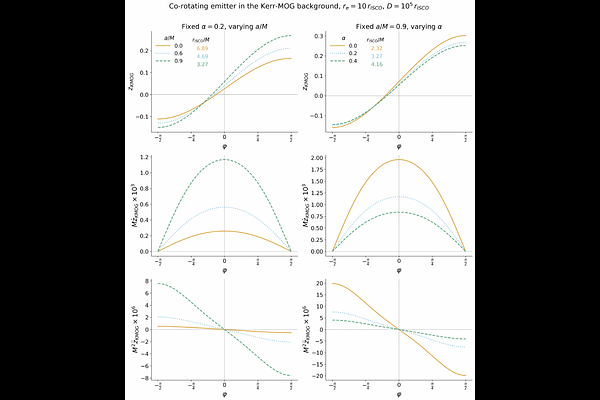
AbstractWe apply a general relativistic framework to static and rotating black hole solutions in Scalar-Tensor-Vector Gravity or modified gravity (MOG). Our results yield exact analytic, closed-form relations expressing the mass $M$, the MOG coupling parameter $α$, and the distance $D$ of a Schwarzschild-MOG black hole in terms of a minimal set of directly measurable elements of the accretion disk: the total frequency shift, the telescope aperture angle, and the redshift rapidity. The resulting expressions are derived for particles close to the midline and line of sight, where the redshift rapidity is treated as a relativistic invariant encoding the evolution of the frequency shift with respect to the emitter's proper time in MOG spacetime. We further extend the formalism to the rotating Kerr-MOG geometry and obtain corresponding relations that determine the rotation parameter $a$ jointly with $M$, $α$, and $D$ on the midline. In the rotating background, we introduced the redshift acceleration (general-relativistic version of jerk) to disentangle the spacetime parameters. Crucially, the explicit appearance of $α$ in these formulas enables direct empirical estimation of this parameter, thereby providing a means to test for departures from standard general relativity. The previous results obtained in the standard Schwarzschild/Kerr backgrounds are recovered in the limit $α\to 0$. The derived expressions are concise and suitable for incorporation into black hole parameter-estimation pipelines.