Challenges in reconstituting the peroxiredoxin 2:STAT3 transient redox-relay complex in vitro

Challenges in reconstituting the peroxiredoxin 2:STAT3 transient redox-relay complex in vitro
Malo Pueyo, J.; Baranova, E.; Wahni, K.; Dubach, V. R. A.; Janvier, S.; Vertommen, D.; Murphy, B. J.; Ezerina, D.; Messens, J.
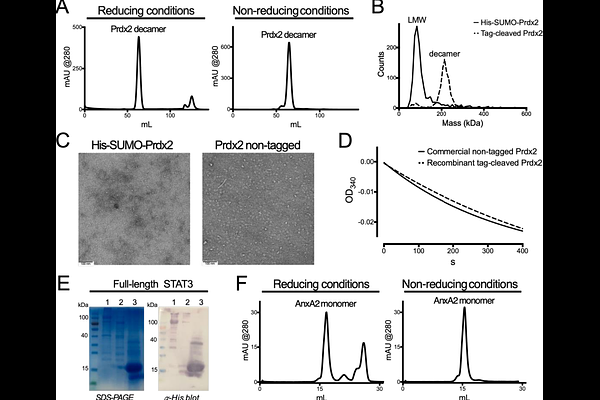
AbstractPeroxiredoxin 2 (Prdx2) mediates redox signaling by transferring oxidative equivalents to target proteins such as STAT3, a redox-sensitive transcription factor implicated in inflammation and cancer. Although this interaction has been demonstrated in cells, reconstituting the Prdx2:STAT3 complex in vitro remains challenging due to its transient and redox-dependent nature. Here we test various conditions to stabilize the complex between taggless Prdx2 and the core fragment of STAT3 (CF-STAT3), including oxidants, detergents, the facilitator Annexin A2, anaerobic environments, and CovalX crosslinking. Complex formation was assessed via mass photometry, analytical size-exclusion chromatography (SEC), SEC-MALS, and electron microscopy (EM). No stable complex was observed under standard conditions. Anaerobic environments briefly stabilized the interaction, but cryo-EM could not resolve the structure. CovalX crosslinking yielded short-lived but homogeneous complexes. We found that Prdx2 is highly susceptible to hyperoxidation at its peroxidatic cysteine, particularly in the presence of DTT or excess H2O2, resulting in loss of function. Maintaining non-reducing conditions during purification preserved Prdx2 in an oxidation-competent state, promoting formation of the disulfide bond between the peroxidatic and resolving cysteines and thereby enabling reproducible detection of a weak complex with CF-STAT3. Our findings establish a framework for studying redox-relay protein complexes in vitro and highlight the importance of oxidation state management during protein handling.