Live high-content imaging with automated analysis reveals mitochondrial changes during vascular calcification

Live high-content imaging with automated analysis reveals mitochondrial changes during vascular calcification
Lee, J.-E.; Torres, A. S.; Punnakka, A. R.; Tan, X.; Cholewa-Waclaw, J.; Kardoost, A.; Tang, Q.; Leighton, C.; Leong, J.; Greenslade, D. B.; Prasad, D. K.; Semple, R. K.; Hulme, A. N.; Marr, C.; Horrocks, M. H.; MacRae, V. E.
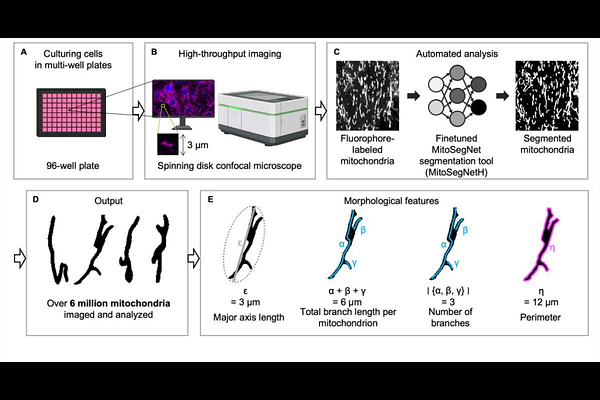
AbstractMitochondrial dysfunction is implicated in a wide range of disorders, including cancer, neurodegeneration, and cardiovascular diseases. Conventional assays typically assess mitochondrial function by measuring bulk respiration rates across thousands of cells. While informative, these approaches cannot resolve the behavior of individual mitochondria, may overlook rare mitochondrial events, and often lack sensitivity to subtle changes. Fluorescence microscopy provides single-organelle resolution but is usually low throughput; for example, imaging 1000 cells can require from 20 minutes to an entire day depending on imaging mode. Additionally, analysis of fluorescence images frequently relies on manually selected thresholds, introducing potential bias and variability due to differences in signal-to-background ratios across cells. Here, we present a High-throughput Mitochondrial Imaging Platform (H-MIP) combined with a deep learning segmentation model, enabling rapid imaging and automated characterization of mitochondrial morphology in millions of mitochondria from tens of thousands of cells. We demonstrate the utility of H-MIP by assessing mitochondrial morphology following treatment with Mdivi-1, an inhibitor of mitochondrial division. Furthermore, we employ an in vitro disease model (vascular calcification) to show that mitochondria become elongated in vascular smooth muscle cells undergoing pathological calcification. Overall, H-MIP provides a scalable and robust tool for investigating mitochondrial structure, with the potential to accelerate therapeutic discovery targeting mitochondrial health.