Spatial Single Cell Lipid-Transcriptomic Coupling Reveals Metabolic Niches in Glioblastoma

Spatial Single Cell Lipid-Transcriptomic Coupling Reveals Metabolic Niches in Glioblastoma
Hendriks, T. F. E.; Eijkel, G. B.; Broen, M. P. G.; Hoeben, A.; De Vleeschouwer, S.; Heeren, R. M. A.; Cuypers, E.
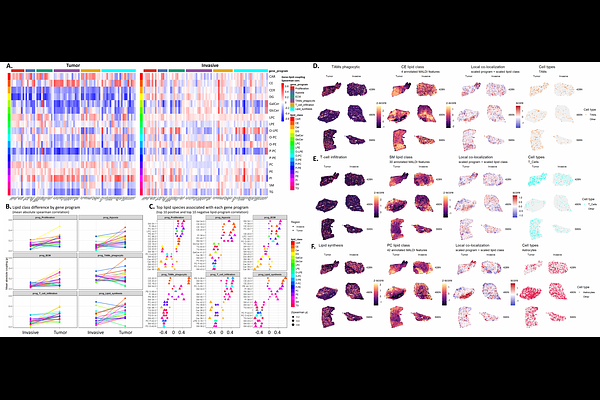
AbstractGlioblastoma is characterized by spatial heterogeneity, with tumor-core and invasive-edge regions differing in cellular composition, transcriptional state, and metabolic context. Spatial transcriptomics has improved understanding of glioblastoma tissue organization. However, cellular transcriptional programs and metabolic interpretation remain poorly resolved. Here, single-cell matrix-assisted laser desorption ionization mass spectrometry imaging (MALDI-MSI) with spatial transcriptomics were integrated on the same tissue sections to map lipid and transcriptomic organization across matched tumor-core and invasive-region samples from 10 glioblastoma patients. Common region-dependent cellular organization along the core - versus invasive regions were identified after accounting for patient specific signatures. Tumor cores were enriched with astrocyte-like malignant and immune cell types, whereas invasive regions showed increased contribution from oligodendrocyte (progenitor cells). Despite these compositional differences, tumor and invasive cells had a shared transcriptional state space, indicating that regional identity is shaped by altered spatial organization of shared cell states. Transcriptional programs associated with proliferation, hypoxia, extracellular matrix remodeling, tumor associated macrophages and microglia (TAMs) phagocytic activity, T-cell infiltration, and lipid synthesis were spatially structured and differed between tumor and invasive compartments. MALDI-MSI revealed broad lipidomic remodeling across these regions. Tumor regions were enriched in membrane and storage lipid classes, whereas invasive regions showed relative enrichment of lipid species associated with membrane turnover. Integrating lipid and transcriptomic layers revealed spatial lipid-gene program coupling, with tumor cores showing stronger and more coherent coupling than invasive regions. TAM phagocytic activity co-localized with cholesteryl ester abundance, while lipid synthesis coupled to phosphatidylcholine-rich astrocyte-like tumor niches. Exploratory analysis indicated that MGMT promoter methylation may be associated with this altered lipid-transcriptional coupling, particularly in TAM-associated lipid-handling programs. Together, these findings imply that spatial coordination between lipid states and transcriptional programs is a key feature of glioblastoma metabolic heterogeneity.