The Emerging Population of High-energy Emitting Radio Galaxies

The Emerging Population of High-energy Emitting Radio Galaxies
G. Bruni, V. S. Paliya, D. J. Saikia, L. Bassani, R. D. Baldi, E. Bronzini, F. D'Ammando, S. del Palacio, M. Kadler, Y. Y. Kovalev, D. V. Lal, G. Migliori, B. Mingo, J. Moldon, L. Ostorero, F. Panessa, M. Persic, I. Prandoni, L. Ricci, T. Savolainen, F. Shankar, F. Tavecchio, E. Traianou, F. Ubertosi, T. Venturi
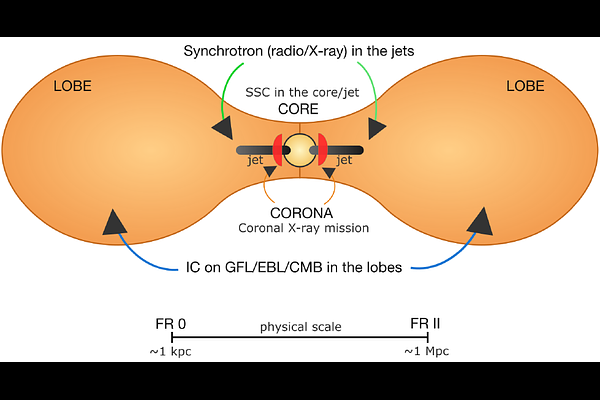
AbstractHigh-energy emission from radio galaxies provides a unique laboratory to study the connection between accretion, jet formation, and particle acceleration in active galactic nuclei (AGN). The recent detection of $γ$-ray emission from misaligned radio galaxies - including Compact Symmetric Objects (CSOs), FR0, FRI/II, and even Giant Radio Galaxies (GRGs) - has shown that efficient particle acceleration is not limited to blazars, but occurs throughout the full radio-loud AGN population. This finding supports a unifying framework where leptonic synchrotron, synchrotron self-Compton (SSC), and external inverse-Compton (EIC) processes coexist across multiple spatial scales, from the inner jet and corona to the extended lobes, possibly with a hadronic contribution in dense environments. The Square Kilometre Array (SKA) will be pivotal in advancing this field. SKA1-Low will detect and characterize diffuse, low-surface-brightness emission tracing aged plasma and jet duty cycles. SKA1-Mid will enable high-resolution spectral and polarimetric studies of compact jets and nuclear regions, while SKA-VLBI will connect parsec- to kiloparsec-scale structures, identifying the exact sites of high-energy dissipation. In synergy with forthcoming high-energy missions such as NewAthena and CTAO, SKA will provide the first spatially resolved, multi-scale view of particle acceleration and energy release in misaligned AGN, unveiling the physical link between the central engine and its large-scale feedback on the host galaxy evolution.