Magneto-Active Environments in Pulsar Binaries with the MeerKAT Telescope: I. Pulsar sample and their basic properties

Magneto-Active Environments in Pulsar Binaries with the MeerKAT Telescope: I. Pulsar sample and their basic properties
Jaikhomba Singha, Dongzi Li, Marisa Geyer, Maciej Serylak, Federico Abbate, Senate Lekomola, Robert Main, Andrea Possenti, Amanda Weltman
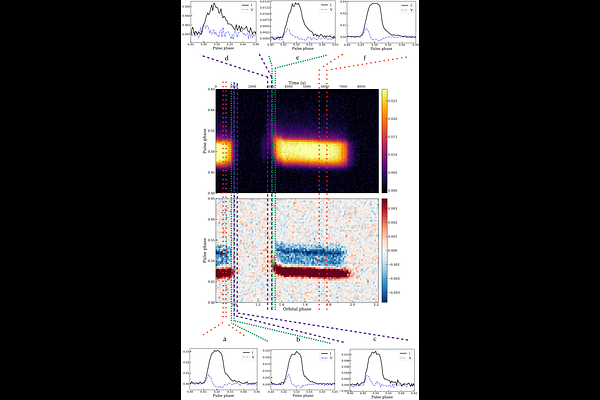
AbstractEclipsing pulsar binaries and binaries with a high mass companion are ideal systems for studying and understanding the properties of plasma in magneto-ionic environments. In this work, the first paper of a series, we present MeerKAT observations of three pulsar binaries: the high-mass binary PSR J1740$-$3052, the black widow PSR J2051$-$0827 and the redback PSR J1748$-$2446A (Terzan~5A). With the help of MeerKAT's high-sensitivity polarimetric observations, we characterise the properties of these sources, including the linear/circular polarization, dispersion measure (DM), rotation measure (RM) and scattering time. The two eclipsing millisecond pulsars exhibit strong orbital-phase-dependent propagation effects and we observe $\sim$2 eclipses in these systems during our observations. PSR J1740$-$3052 is a binary system with a 231 d orbital period. The relatively large separation results in a smooth RM variation, enabling us to resolve its variation timescale and constrain the small-scale magnetic structure. A gradual RM variation is observed over $\sim$1500 s, occurring near periastron. This behaviour implies a magnetic spatial scale of $\sim$0.003 AU in the companion wind, assuming a relative velocity of $\sim$250 km s$^{-1}$. The linear polarisation intensity profiles of PSR J2051$-$0827 show shape variations as a function of frequency, with a stronger leading component emerging at lower frequencies. We observe signatures of the propagation effect in the polarisation properties of PSR J1748$-$2446A during eclipse ingress and egress. This could arise from Faraday Conversion or multipath propagation of the pulsar signal and requires detailed analysis.