Stochastic Mechanism of Dominant Follicle Selection: Selection of One Suppresses Selection of Others

Stochastic Mechanism of Dominant Follicle Selection: Selection of One Suppresses Selection of Others
Lyu, Z.; Kolomeisky, A.
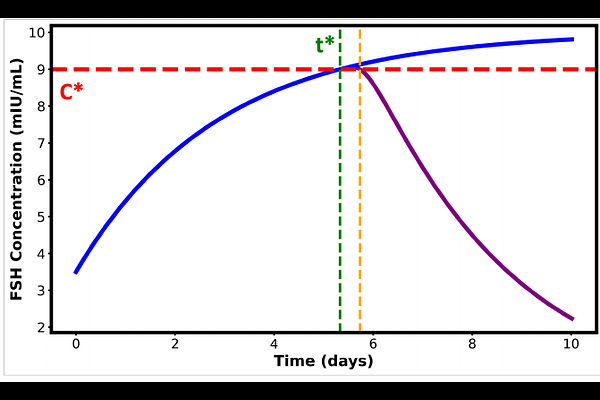
AbstractOne of the most critical steps in human reproduction is the selection of the dominant follicle when a single follicle is chosen from a large group of follicles to ovulate. Although this process involves complex hormonal regulation, the complete microscopic picture of unique selectivity remains unclear. We propose a novel stochastic mechanism for dominant follicle selection that incorporates the actions of the most relevant hormones, follicle-stimulating hormone (FSH) and estradiol. Our theoretical picture suggests the following sequence of events. As soon as the FSH concentration reaches the critical threshold, one of the available follicles is randomly selected, which immediately stimulates the production of estradiol, which, via a negative feedback mechanism, suppresses further FSH production, lowering its concentration below the critical threshold. This suppression limits the time window for the possible second follicle selection event, allowing only a single follicle to be selected. Based on this picture, a minimal quantitative theoretical model of dominant follicle selection is developed and analyzed using analytical calculations and computer simulations. Theoretical analysis shows how the interplay between different parameters that govern follicle selection leads to high selectivity. Our theoretical approach can explain some key known observations, providing a quantitative tool for analyzing biological reproduction phenomena.