Fitting the light curves of tidal disruption events with non-parabolic model

Fitting the light curves of tidal disruption events with non-parabolic model
Shiyan Zhong, Chenxi Shang, Xiaowei Liu
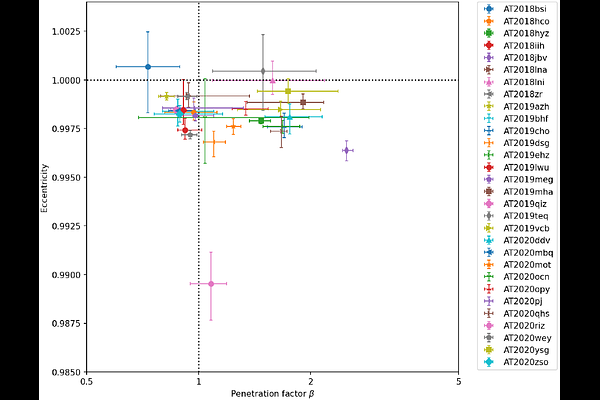
AbstractTidal disruption events (TDEs) are powerful probes of supermassive black hole (SMBH) properties and accretion physics. The existing light curve fitting tools assume that the disrupted stars are on parabolic orbits, which may introduce systematic biases in derived parameters. In this work, we develop a non-parabolic TDE model that incorporates orbital energy of the disrupted star as a free parameter ($\tildeε_{\rm orb}$) to modify the debris mass distribution and mass fallback rate. We apply this model to 30 TDEs from the ZTF-I survey and compare the results with those from a standard parabolic model. We find that neglecting orbital energy leads to biased black hole mass estimates: for eccentric (hyperbolic) orbits, parabolic models systematically underestimate (overestimate) the black hole mass. Additionally, we measure orbital eccentricities ($e$) and penetration factors ($β$) of the disrupted stars in this sample, enabling an investigation of their origins via the $e$-$β$ parameter space. Most events (24/30) are consistent with production via two-body relaxation in spherical nuclear star clusters, but six outliers with high $β$ and $e<1$ suggest alternative mechanisms. Our results highlight the importance of accounting for orbital energy in TDE modeling to improve the accuracy of SMBH mass measurements and to better understand the dynamical origin of the disrupted stars.