Non-Monotonic Rotation Imprint on Time-Integrated Neutrino Spectral Moments in a 15\,$M_\odot$ Core-Collapse Supernova Sequence

Non-Monotonic Rotation Imprint on Time-Integrated Neutrino Spectral Moments in a 15\,$M_\odot$ Core-Collapse Supernova Sequence
Nicolas Viaux
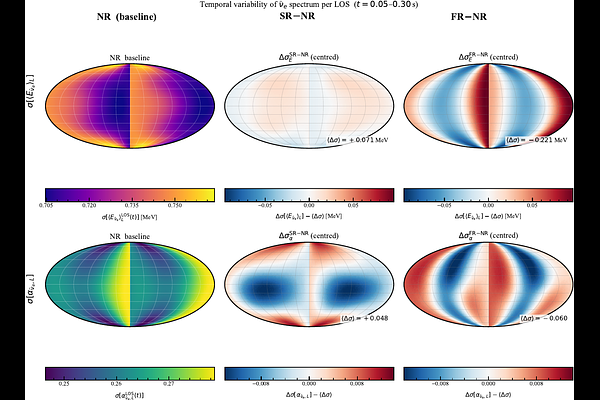
AbstractWe study the early post-bounce neutrino signal of the published Garching $15\,M_\odot$ rotating core-collapse supernova (CCSN) sequence consisting of non-rotating (NR), slowly rotating (SR, $Ω_0=0.5$ rad\,s$^{-1}$), and fast-rotating (FR, $Ω_0=150$ rad\,s$^{-1}$, artificially boosted ${\sim}300{\times}$) three-dimensional models. We present a new analysis of these publicly available simulation data; no new simulations were performed. Our central result, for this specific model sequence, is that SR and FR shift the integrated spectral moments in \emph{opposite directions} relative to NR: FR drives the spectra toward softer, more-pinched states, while SR moves them weakly toward harder, less-pinched states. Placed in a spectral-shift plane $(Δ\langle E\rangle_L,\,Δα_L)$, NR sits at the origin, and SR and FR occupy \emph{diagonally opposite quadrants}, making the non-monotonic response immediately visible as an anti-correlation in two spectral dimensions simultaneously. The focus is the accretion interval $t_{\rm pb}=0.05$--$0.30$\,s, where the rotation imprint is strongest. Quantitatively, fast rotation produces $Δ\langle E_{ν_e}\rangle_L=-0.513$\,MeV and $Δα_{ν_e}=+0.161$, with corresponding shifts $Δ\langle E_{\barν_e}\rangle_L=-0.440$\,MeV and $Δα_{\barν_e}=+0.173$; the SR shifts are an order of magnitude smaller and in the opposite sense. The fast-rotation signature is coherent across all $15\,488$ lines of sight and is established during early accretion. With only three models from a single progenitor family, this result is a phenomenological characterization of one published sequence and a suggestive indication of a non-monotonic, possibly strongly nonlinear, rotational response within this sequence; the functional form and generality of the dependence on $Ω_0$ remain unconstrained.