AI-Driven Reconstruction of the Research Paradigm for Phase Separation in Membraneless Organelle

AI-Driven Reconstruction of the Research Paradigm for Phase Separation in Membraneless Organelle
ding, y.; lu, t.; Li, y.
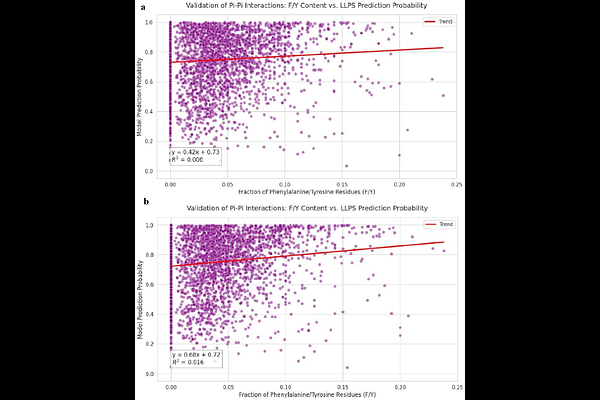
AbstractLiquid-liquid phase separation (LLPS) of biomacromolecules is a key mechanism driving the formation of membraneless organelles (MLOs) within cells, playing a crucial role in fundamental biological processes such as cell proliferation and stress response. Accurately understanding and predicting the phase separation propensity of proteins is essential for unraveling the assembly mechanisms of MLOs and their functions under both physiological and pathological conditions. Traditional research methods primarily rely on biochemical experiments, which are limited by low throughput, high cost, and difficulty in systematically exploring sequence-phase transition relationships. This study proposes and implements a novel three-stage, iterative paradigm based on artificial intelligence (AI) to propel phase separation research towards systematization, predictability, and mechanistic understanding. 1) Benchmark Model Construction: A preliminary predictive model was established based on a Multilayer Perceptron (MLP) neural network, and the driving effect of phenylalanine/tyrosine (F/Y) residue-mediated {pi}-{pi} interactions on LLPS was validated. 2) Model Robustness Enhancement: The model was optimized through adversarial training strategies, which effectively identified and eliminated misclassifications of "highly disordered non-phase-separating" trap sequences. This significantly improved the model's generalization capability and reliability when handling complex, real-world sequences. 3) Physical Mechanism Integration and Functional Expansion: Incorporating the Uniform Manifold Approximation and Projection (UMAP) manifold learning method and constraints from non-equilibrium thermodynamics, a "fingerprint space" capable of characterizing the thermodynamic behavior of phase separation was constructed. This space enables cluster analysis of different MLO types, and the model can output a thermodynamic stability score for protein phase separation. Based on this score, we identified 10 high-confidence candidate proteins with the potential to form novel MLOs. The paradigm established in this study upgrades phase separation prediction from the traditional "binary classification" approach to a novel research framework characterized by "physical mechanism analysis + novel MLO discovery." It provides the phase separation field with a computational tool that combines high accuracy, strong robustness, and good physical interpretability.