Continuous, Low Latency Estimation of the Size and Shape of Single Proteins from Real-Time Nanopore Data

Continuous, Low Latency Estimation of the Size and Shape of Single Proteins from Real-Time Nanopore Data
Li, Y.; Ying, C.; Mayer, M.
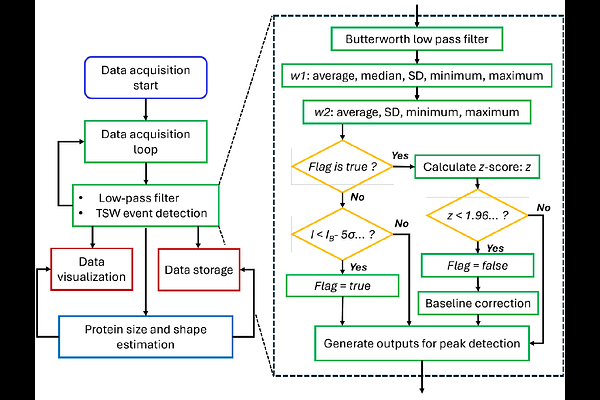
AbstractExisting approaches for nanopore sensing typically analyze resistive pulses from the translocation of individual proteins through the nanopore after completing the experiment. This approach foregoes instantaneous protein identification and precludes real-time experimental control. Here, we introduce a method for the analysis of real-time nanopore data capable of characterizing the size and approximate shape of proteins within a millisecond response time during data acquisition. The implemented real-time Two-Sliding Window (TSW) peak detection algorithm makes it possible, for the first time, to filter data, process baselines, and extract resistive pulse information during nanopore recordings using a stream of single data points. This approach achieves a computational throughput of 40 MB/s on a 1.8 GHz laptop CPU. We compared the accuracy of dwell time determination of the TSW algorithm with an established offline threshold searching (TS) algorithm, using simulated resistive pulses. The TSW algorithm accurately extracted events with dwell times greater than 1.5 times the reciprocal of the system cutoff frequency, 1.5 * (fc)-1. Moreover, the TSW algorithm effectively determined the dwell time of resistive pulses with large intra-event modulation, which is crucial for resolving non-spherical protein-induced fluctuations. Finally, we verify experimentally that integrating the TSW algorithm into the data acquisition process makes it possible to determine the approximate shape and volume of proteins within low-millisecond response times. This real-time data analysis approach potentially provides instant feedback control for manipulating single proteins during or immediately after translocation. This analysis also improves data storage efficiency during recordings with a high sampling rate.