Structure-guided computational design and mechanistic understanding of the p95HER2-targeting NAZ-mAb antibody and its variants

Structure-guided computational design and mechanistic understanding of the p95HER2-targeting NAZ-mAb antibody and its variants
Rawat, P.; Kyte, J. A.; Greiff, V.; Dorraji, E.
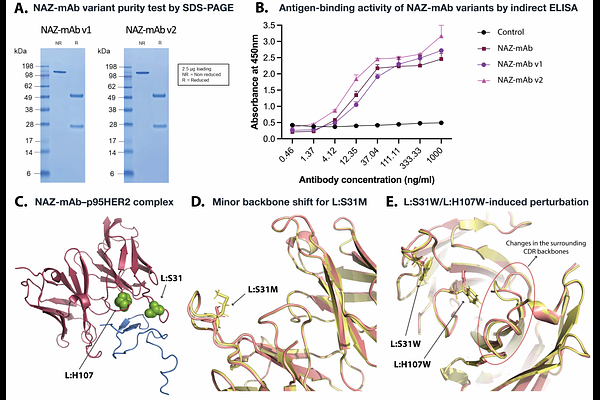
AbstractHuman epidermal growth factor receptor 2 (HER2) is an oncogenic receptor tyrosine kinase in breast cancer and other malignancies. A subset of HER2-positive tumours expresses 611-CTF-p95HER2, a tumour-specific, hyperactive truncated isoform associated with metastasis and treatment resistance that lacks most of the extracellular domain targeted by conventional HER2-directed antibodies. We previously developed NAZ-mAb (formerly known as Oslo-2), a monoclonal antibody against 611-CTF-p95HER2. Here, we describe a computational antibody-engineering workflow for designing variants of NAZ-mAb. Starting from the sequence alone, we modeled the NAZ-mAb-611-CTF-p95HER2 complex, generated a combinatorial mutational landscape using FoldX 5.0, and prioritized candidate variants using predicted interaction energy and developability criteria. Two variants representing distinct design strategies were selected for validation: an aromatic double mutant, NAZ-mAb v1 (L:S31W/L:H107W), and a conservative single mutant, NAZ-mAb v2 (L:S31M). Both variants were successfully expressed as recombinant IgGs; NAZ-mAb v2 achieved a five-fold higher recombinant expression yield than parental NAZ-mAb, while both variants retained antigen binding with a higher apparent signal than the parental antibody in indirect ELISA. However, Biacore two-state kinetic analysis revealed weaker affinities than the parental antibody (KD NAZ-mAb v1: 32.6 nM, NAZ-mAb v2: 9.45 nM vs. parental NAZ-mAb: 5.33 nM). These findings show that the computational workflow can generate experimentally tractable, antigen-engaging NAZ-mAb variants, while also highlighting the limitations of fixed-backbone interaction-energy ranking as a predictor of binding affinity and yield. This study provides a practical framework for computationally driven, developability-aware antibody optimization in the absence of experimental structural data.