Optimized cryo-FIB milling strategy to generate thin, minimally damaged biological lamellae

Optimized cryo-FIB milling strategy to generate thin, minimally damaged biological lamellae
Hall, L. N.; Paul, J.; Ngo, P.; Lucas, B. A.
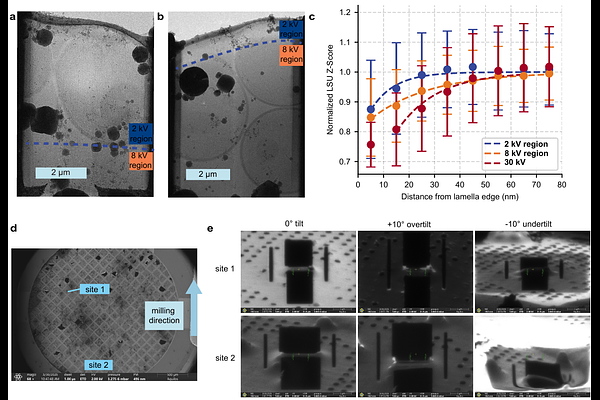
AbstractFocused ion beam (FIB)-milling has been adapted to thin frozen cells for visualization of macromolecular structures in situ with cryogenic electron microscopy. However, only a few large and abundant complexes have been annotated to date. FIB-milling introduces damage which limits the recoverable information from cellular sections. Here, we present Nilas, a low-energy milling strategy optimized to minimize damage and produce thin lamellae. Nilas-milled lamellae show minimal FIB-milling damage, contain areas at or below 50 nm and produce higher resolution in situ 3D reconstructions. Nilas improves the recovery of ribosomal subunits and reduces the predicted minimal detectable molecular mass with two-dimensional template matching (2DTM) to approximately 220 kDa. Consistently, we recover additional non-ribosomal complexes including RNA polymerase III with 2DTM in Nilas-milled lamellae. Nilas is compatible with common milling hardware, making it accessible to diverse users. By extending the size limit for in situ structural biology we bring visual proteomics closer to reality.