Potential detection of ~ 4.2 keV emission line from GRS 1747-312

Potential detection of ~ 4.2 keV emission line from GRS 1747-312
Amom Lanchenbi Chanu, Akash Garg, Ranjeev Misra, A. Senorita Devi
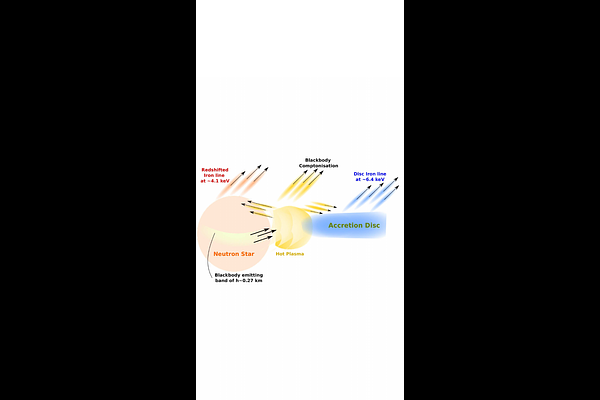
AbstractWe present a broadband spectral analysis of the neutron star LMXB GRS 1747-312 using $\sim 40$ ks AstroSat data. The source was observed during the decay phase of the 2017 outburst, with an absorbed 1.0--5.5 keV flux of $1.67^{+0.04}*{-0.07} \times 10^{-11}$ erg s$^{-1}$ cm$^{-2}$, corresponding to a luminosity of $\sim (0.9-1.80) \times 10^{35}$ erg s$^{-1}$. The continuum is modeled with thermal Comptonization of blackbody emission and interstellar absorption. A mildly broad iron line at $\sim 6.4$ keV is fitted with a disc reflection component. Narrow lines below 2 keV are described by a hot plasma using the XSPEC model APEC. Additionally, there is a potential detection of an emission line at $4.19^{+0.12}*{-0.10}$ keV with width $σ= 0.2 \pm 0.2~\mathrm{keV}$ and line flux = $13^{+10}*{-9} \times 10^{-5}$ erg s$^{-1}$ cm$^{-2}$. Examination of several short duration ($\sim$ few kiloseconds) Swift observations at few times the AstroSat source flux, provided upper limits to the line flux $< 30 \times 10^{-5}$ erg s$^{-1}$ cm$^{-2}$. The 4.2 keV line likely originates from reflection off the neutron star surface. Shifting the neutral Fe $K*α$ line from its rest energy of 6.4 to 4.2 keV requires a redshift of $z \sim 0.6$, consistent with that expected from the surface of a non-spinning $1.4 M_\odot$, 10 km radius neutron star. If confirmed, this feature provides a potential direct measurement of gravitational redshift, allowing us to place strong constraints on the neutron star's mass-to-radius ratio and gain valuable insights into the equation of state (EOS) of dense matter.