Partial epithelial-to-mesenchymal transition mediates profound gap closure through growth and fluidization

Partial epithelial-to-mesenchymal transition mediates profound gap closure through growth and fluidization
Jiang, H.; Wei, C.; Wang, P.; Johnson, J.; Olaranont, N.; Gu, Y.; Chen, F.; Xu, J.; Wen, Q.; wu, m.; Sun, Y.
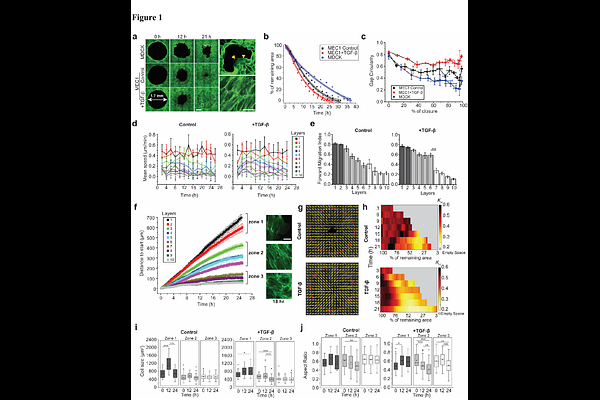
AbstractEpithelial gap closure is essential for maintaining tissue integrity during development and wound healing. Previous studies have shown that closure of small gaps is driven by actomyosin purse-string contraction and traction forces generated at the gap edge. Here, we show that millimeter-scale circular gap closure in mouse epicardial (MEC1) monolayers is driven primarily by growth-mediated compressive stresses. Compared with MDCK monolayers, MEC1 cells close gaps more rapidly with reduced undulation near gap edge through coordinated tissue-wide extension-contraction. The collective closing dynamics can be modulated by partial epithelial mesenchymal transition induction and Rho kinase inhibition. By integrating tissue and cell kinematic analyses, traction force mapping, and a continuum framework that decomposes tissue strain rates into growth, elastic, and fluidity related contributions, we reveal that growth-generated compression drives inward tissue flow, while elastic cell elongation and fluid-like tissue remodeling through cell cell intercalation act synergistically to accommodate deformation and promote robust collective gap closure.