Psi RNA-specific Binding Promotes HIV-1 Gag Conformational Change Critical for Immature Viral Particle Assembly

Psi RNA-specific Binding Promotes HIV-1 Gag Conformational Change Critical for Immature Viral Particle Assembly
Qiu, Y.; Banerjee, P.; Grabarkewitz, K.; Wysocki, V. H.; Rouzina, I.; Voth, G. A.; Musier-Forsyth, K.
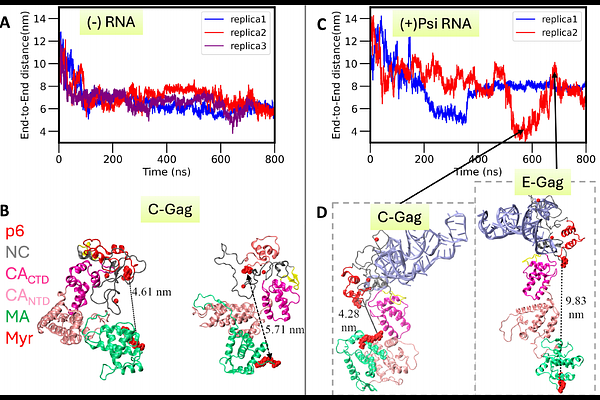
AbstractThe immature HIV-1 virion is assembled by the Gag polyprotein using inositol hexakisphosphate (IP6) as an essential assembly co-factor. Gag binds the genomic RNA Psi packaging signal via the nucleocapsid (NC) domain and associates with the plasma membrane via the matrix (MA) domain. Previous studies revealed that Gag exists in both compact (C) and extended (E) conformational states in solution. Only E-Gag formed virus-like particles with the correct size and IP6 shifted the equilibrium of DNA-bound Gag to the E state. The influence of specific RNA elements on this conformational change is unknown. In this work, a dual dye-labeled Gag was prepared for probing the effect of RNA binding on Gag conformation using Forster resonance energy transfer (FRET). In low salt and in the absence of other factors, Gag was primarily in the C state. Psi RNA binding induced a more significant FRET decrease than binding to non-Psi RNAs, consistent with a shift to E-Gag. IP6 alone also promoted the E-Gag state in the absence and presence of RNA. Atomistic molecular dynamics simulations are consistent with and provide detail into the role of NC-Psi RNA binding in the conformational switch of C-Gag to assembly-competent E-Gag. Simulations also showed that this switch is driven by capsid (CA) linker domain orientational flexibility and MA-CA unbinding dynamics. Thus, the highly flexible multi-domain Gag polyprotein leverages both viral and host cell factors to sample and stabilize distinct conformations, thereby orchestrating the viral assembly process.