Dissecting the Network Architecture of a Plant Circadian Clock Model: Identifying Key Regulatory Mechanisms and Essential Interactions

Dissecting the Network Architecture of a Plant Circadian Clock Model: Identifying Key Regulatory Mechanisms and Essential Interactions
Singh, S. K.; Srivastava, A.
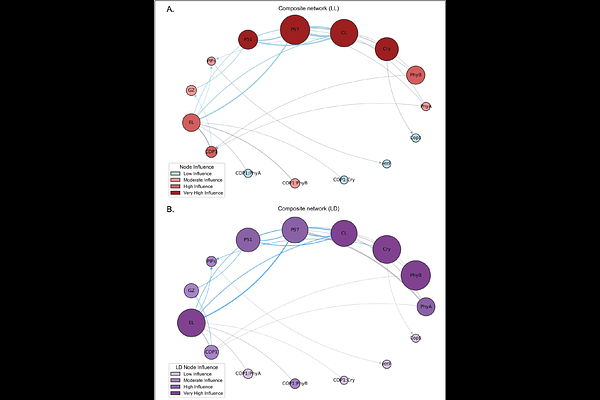
AbstractCircadian rhythms are self-sustained biological oscillations that coordinate diverse physiological processes in plants, including growth, metabolism, and environmental responses. These rhythms arise from an interconnected transcriptional translational feedback network that integrates multiple entrainment cues such as light and temperature. The plant circadian clock is organized around key regulatory loops involving CCA1, LHY, PRRs, TOC1, ELF4, LUX, and other transcriptional regulators, whose coordinated interactions ensure precise and robust oscillations. In this study, we developed an ordinary differential equation based mathematical model, building upon a previous framework to incorporate additional regulatory modules and transcriptional controls that better reflect experimentally observed behaviour. To elucidate the regulatory organization of this model, we performed a multi-layered computational analysis combining four complementary approaches: (i) period sensitivity analysis to quantify how parameter perturbations influence the system's timing, (ii) phase portrait analysis to visualize dynamic interactions among key components, (iii) knockout analysis to identify parameters essential for sustained rhythmicity, and (iv) network impact analysis using composite weighted network indices to evaluate hierarchical control across the network. Together, these analyses reveal that transcriptional repression, protein degradation, and light-regulated synthesis form the dominant control mechanisms within the circadian system. The results highlight a hierarchical and robust network structure centred on the CCA1/LHY and PRRs feedback loop, with redundant modules ensuring stability under perturbations. Thus, this model provides an improved, biologically consistent framework for dissecting the dynamic architecture of the plant circadian clock and guiding future experimental validation.