Reconstructing Actin Dynamics of the Leading Edge from Observational Data

Reconstructing Actin Dynamics of the Leading Edge from Observational Data
Shi, W.; Miles, C.; Noh, J.; Danuser, G.; Mogilner, A.
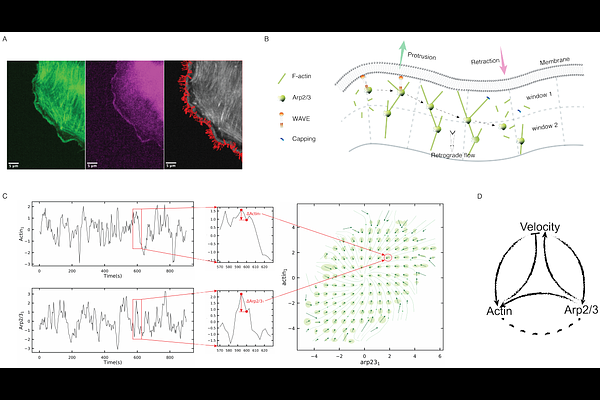
AbstractMesenchymal cell migration starts with the protrusion of the cell's leading edge, enabled by the branching growth of the actin network. Two crucial molecular players in protrusion are actin filaments and the Arp2/3 protein complex, the branching agent. Traditionally, protrusion models are intuited from several perturbative experiments. Recent multiplex microscopy imaging data promise to drastically change this paradigm by providing measurements of naturally fluctuating densities of key proteins at the leading edge of unperturbed cells. We report the first attempt to reconstruct the mechanistic protrusion model from such data. We analyze fluctuations of F-actin and Arp2/3 densities and cell edge velocity using phase space and regression analysis to reconstruct linearized stochastic actin-Arp2/3-velocity coupled dynamics. We then build a nonlinear partial differential equation model of these dynamics based on previous knowledge of this system and parsimony. The resulting model recovers the rates of reactions and mechanical and transport processes in the lamellipodium from a single non-perturbative experiment. The model posits that the only essential nonlinearities in the lamellipodial dynamics stem from the retrograde flow of F-actin. The model suggests that the protrusion is dominated by a damped oscillatory cycle resulting from a combination of positive feedback from Arp2/3 to protrusion velocity and negative feedback from F-actin to the velocity.