Impact of retroactivity on information flows in engineered synthetic biological circuits

Impact of retroactivity on information flows in engineered synthetic biological circuits
Moirangthem, S. S.; Raman, K.
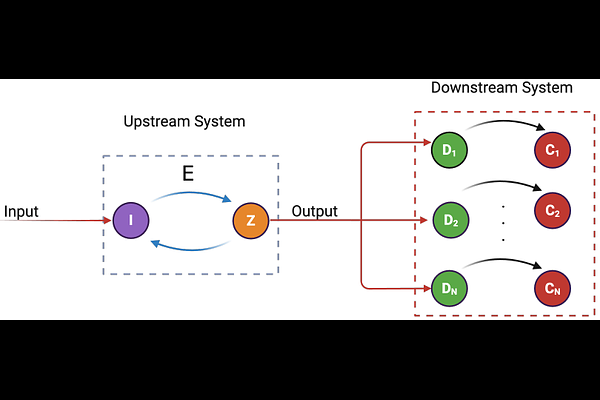
AbstractIn biological networks, retroactivity describes the feedback from downstream components that can influence and alter the behavior of upstream systems. This effect poses a major challenge to the modular design of synthetic circuits, where upstream modules are expected to function independently of their connections. Beyond disrupting dynamics, retroactivity can also interfere with how information is transmitted through a network, acting as a bottleneck that reduces the fidelity of signal propagation. Here, we combine stochastic biochemical modeling with information-theoretic analysis to quantify how retroactivity constrains upstream signaling, even in strongly amplified feedback architectures, particularly in the presence of molecular noise. At the same time, we identify parameter regimes in which retroactivity can be exploited as a functional mechanism: downstream loading can trigger controllable state transitions, enabling circuits that respond to changes in their environment or interconnections. These findings suggest design principles for harnessing retroactivity for programmable signal processing and decision-making in cellular computation. Finally, we evaluate feedback-gain tuning as a mitigation strategy and demonstrate that increasing gain alone is insufficient under noisy conditions. We therefore propose complementary approaches to reduce retroactivity and delineate the operating regimes in which each strategy is most effective.