Numerical shock broadening and supernova neutrino conversion: implications for DUNE

Numerical shock broadening and supernova neutrino conversion: implications for DUNE
Rafael C. R. de Lima, Pedro Martins Bailer
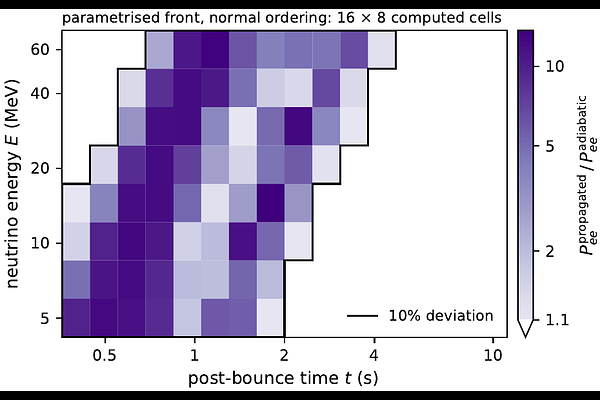
AbstractHydrodynamical simulations spread the supernova shock front over a few grid zones, a width set by the numerical scheme rather than by the physics of the shock. Where the front crosses the H resonance, that width can make the computed MSW evolution artificially adiabatic. We quantify the effect on six three-dimensional blue-supergiant explosion models from the Garching archive by propagating individual rays twice: through the stored profile, and with the front replaced by a narrow reconstruction, 2.2 km wide, that approximates a sudden crossing while keeping the densities on either side. The stored fronts are 1.6 to 1.7 grid zones wide. Across twelve configurations, each chosen inside the energy band in which that model's front meets the resonance, the reconstruction raises the ray-averaged crossing probability $P_H$ by 0.44 to 0.76 in absolute terms, median 0.56; narrowing the reconstruction thirty-fold changes each difference by at most 0.055. Along all 12878 rays of one configuration, the sudden-limit formula evaluated on each ray's own densities agrees closely with the propagated reconstructed result. The change is largest when the density jump spans the resonance, over a band of energies that can be estimated from the presupernova density once the shock radius and the compression are known, with tails outside it. In a separate calculation with a parametrised shock and a published emission model, time-dependent conversion changes the $ν_e$ charged-current count in a 40 kt argon detector by -4.4%, with a sign set by the flavour composition of the source. Folding the reconstructed three-dimensional fronts with a consistent emission model remains to be done.