A phase field model with stochastic input simulates cellular gradient sensing, morphodynamics, and fidelity of haptotaxis

A phase field model with stochastic input simulates cellular gradient sensing, morphodynamics, and fidelity of haptotaxis
Koelbl, J. M.; Haugh, J. M.
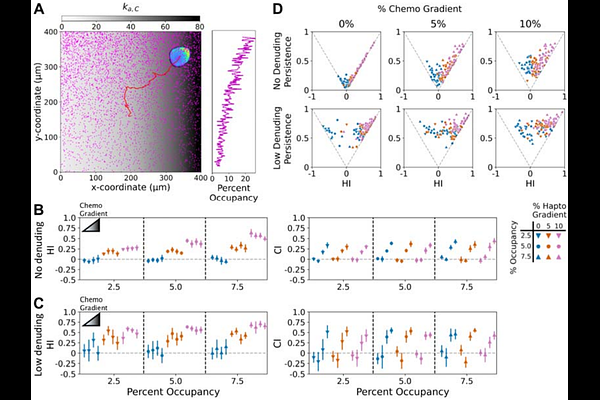
AbstractHaptotaxis is an understudied form of directed cell migration in which movements are biased by gradients of immobilized ligands. For example, fibroblasts and other mesenchymal cells sense and respond to gradients of extracellular matrix (ECM) composition, which is relevant during tissue morphogenesis and repair. As a step towards understanding how haptotactic gradients spatially bias cell adhesion, intracellular signal transduction, and cytoskeletal dynamics, we formulated a phase field model of whole-cell migration, in which the occupancy of potential adhesion sites changes stochastically with time. With careful assignment of parameter values, the model predicts significant haptotactic bias for adhesion-site gradient steepness of a few percent across the cell. We then used the model to predict how the cell's removal of surface-bound ECM ligand (as observed in experiment) and/or the presence of a competing, chemotactic gradient influence(s) haptotactic fidelity. An emergent principle is that gains in directional persistence naturally offset losses of directional bias, at the cost of greater cell-to-cell heterogeneity of the response. In the case of orthogonally oriented gradients, this offset manifests as a remarkable robustness of the multi-cue response.