Integrating epigenomic features reveals principles of chromatin-state organization

Integrating epigenomic features reveals principles of chromatin-state organization
Martini, J.; Williams, R. A.; Smith, R. G.; Zhou, Y.; Liu, Y.
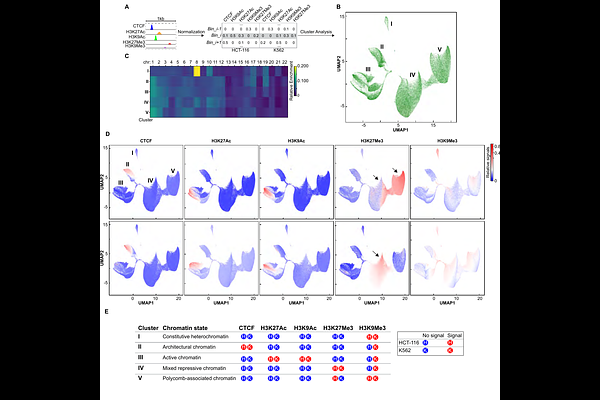
AbstractThe coordinated activities of histone modifications and chromatin-associated proteins establish chromatin states that regulate genome function and cellular identity. However, the organizational principles that distinguish chromatin states across cell types remain incompletely understood. Here, we integrated genome-wide profiles of CTCF, H3K27ac, H3K9ac, H3K27me3, and H3K9me3 at 1-kb resolution to generate a unified representation of chromatin organization in human cells. Unsupervised embedding resolved five principal chromatin states corresponding to constitutive heterochromatin, CTCF-associated architectural chromatin, transcriptionally active chromatin, mixed repressive chromatin, and Polycomb-associated chromatin. Comparative analyses of HCT116 and K562 cells revealed that cell-type-specific epigenomic differences arise predominantly through remodeling of Polycomb-associated chromatin, whereas the remaining chromatin states exhibit broadly similar epigenomic signatures and comparatively limited remodeling. Consistent with this observation, principal component analysis identified H3K27me3 as the primary contributor to genome-wide epigenomic divergence, whereas CTCF represented a secondary contributor. Integration with Hi-C data further demonstrated that CTCF-associated chromatin is strongly enriched at chromatin loop anchors and other local architectural features, linking chromatin-state organization to three-dimensional genome architecture. Together, our findings identify distinct chromatin-state classes that organize the human epigenome and reveal Polycomb-associated chromatin as a key determinant of cell-type-specific epigenomic differences.