Physiomimetic culture bias durotaxis toward soft environments

Physiomimetic culture bias durotaxis toward soft environments
Moro-Lopez, M.; Alonso Matilla, R.; Olive-Palau, S.; Gonez-Gonzalez, M.; Provenzano, P.; Farre, R.; Otero, J.; Odde, D. J.; Sunyer, R.
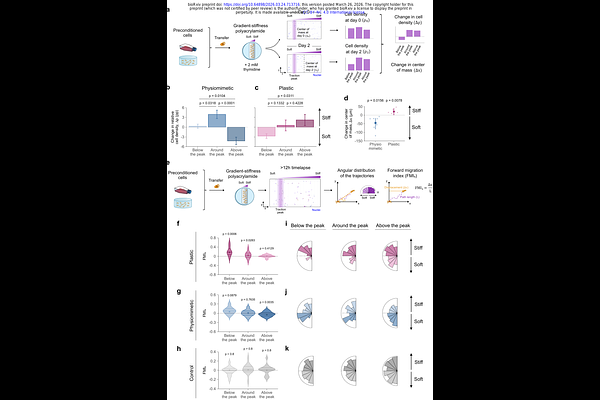
AbstractDirected cell migration underlies many biological phenomena, from embryonic development to tumor metastasis and organ fibrosis. Most cells typically migrate toward stiffer regions of their extracellular matrix -a behavior known as positive durotaxis. Here we show that culture on rigid plastic reinforces this response, whereas preconditioning in soft 3D physiomimetic environments reprograms migration towards softer environments, a phenomenon known as negative durotaxis. Fetal rat lung fibroblasts preconditioned in 3D physiomimetic hydrogels exhibited negative durotaxis and accumulated near ~5 kPa, corresponding to the physiological stiffness of the lung. In contrast, genetically identical cells maintained on conventional 2D plastic substrates migrated up stiffness gradients, toward stiffer regions. Although both populations displayed a biphasic force-stiffness relationship, they differed in force magnitude and cytoskeletal organization. Molecular-clutch modeling revealed that durotaxis reversal emerges from two distinct mechanical regimes: a mechanosensitive, high-motor-clutch state that stabilizes adhesions on stiff substrates and drives positive durotaxis, and a low-motor, weak-adhesion state in which clutch slippage on the stiff side causes negative durotaxis. Our results show that durotaxis direction is not an intrinsic cellular property. Rather, it emerges from the interplay between motor activity and adhesion dynamics and can be tuned by culture conditions.