Differential multi-omics analysis of pulmonary arterial hypertension microvascular endothelial cells for differential drug response

Differential multi-omics analysis of pulmonary arterial hypertension microvascular endothelial cells for differential drug response
Hiort, P.; Weiss, A.; Krentz, J.; Schermuly, R. T.; Bogaard, H.-J.; Conrad, T.; Szulcek, R.; Baum, K.
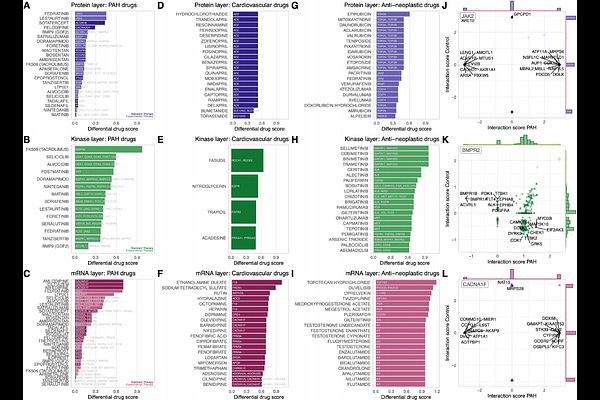
AbstractPulmonary arterial hypertension (PAH) represents a heterogeneous group of disorders that involves complex molecular dysregulations, which are not fully captured by single-omics analyses. We apply our network-based multi-omics analysis framework, DrDimont, to transcriptomic, proteomic, phosphoproteomic, and kinase screening data from lung microvascular endothelial cells of PAH patients and controls. Thereby, we extend the functionality of DrDimont to incorporate kinase-kinase interactions during the construction of condition-specific multi-omics networks. Kinase interactions are inferred from phosphorylations of screened substrates that are weighted by kinase-substrate predictions. Differential interaction scores from the network-based analysis between PAH and control uncover alterations centered on kinases, in particular top hits relating to MAPK signaling, such as MAPK13, MAP2K, or upstream IRAK1, and other MAPK/MAP2K family members. Further highly differential nodes were ACADSB, GPX7, DSE (for proteins), and AIM1, LY96, CHSY3 (for mRNAs). When prioritizing drug candidates by mapping drug targets onto the differential network, we find high scores for the drug tacrolimus (FK506) and several anti-neoplastic MAPK inhibitors (e.g., selumetinib, trametinib), as well as agents acting on general proliferation via (mitochondrial) DNA transcription (e.g., epirubicin, topotecan). Integrating kinase activity screens into our explainable multi-omics network-based analyses reveals kinase-centered alterations and therapeutic hypotheses in PAH that complement single layer classical differential expression analyses.