Extracellular vesicle associated nucleic acids and proteins as a complementary fraction for fish biodiversity monitoring and physiological signal recovery

Extracellular vesicle associated nucleic acids and proteins as a complementary fraction for fish biodiversity monitoring and physiological signal recovery
Hayatov, J.; Lu, L.; Xu, X.; Wu, Y.; Avellan Llaguno, R. D.; Ujong, A. O.; Pan, Z.; Huang, Q.
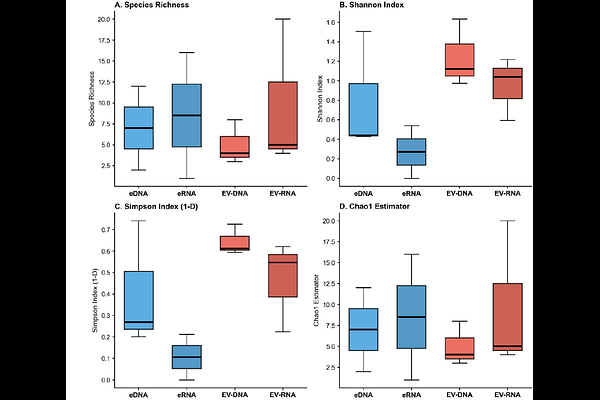
AbstractMonitoring the biodiversity and physiological condition of aquatic organisms under environmental stress is central to aquatic ecosystem management. Environmental nucleic acid methods (eDNA and eRNA) have transformed biomonitoring but face well-documented limitations, including susceptibility to degradation, difficulty distinguishing living from legacy or transported signals, and limited capacity to report organism condition. Extracellular vesicles (EVs) released from all kinds of species, are stable and widespread vesicles in environment, showing biomarker potential. Here we evaluate whether nucleic acids and proteins recovered from EVs provide a complementary capture fraction that helps address these limitations. All four targets (eDNA, eRNA, EV-DNA, EV-RNA) shared an identical 12S rRNA metabarcoding workflow and differed only in the pre-analytical capture step, filtration for bulk environmental nucleic acids versus sequential 0.22 {micro}m filtration, tangential flow filtration, and ultracentrifugation for the EV-encapsulated fraction. In a controlled aquarium, EV-DNA recovered all seven reference species (100% sensitivity) versus 85.7% for bulk methods, including a low-abundance detection of Anguilla japonica that warrants independent confirmation. In field sampling at Xinglinwan Reservoir, EV-RNA recovered 11 of 12 expected species (91.7% sensitivity) compared with 50-58% for bulk methods, including four reference taxa detected only by the EV fraction. EV-based methods also captured more even community representation, and EV-RNA showed lower human-read contamination than eDNA. Metaproteomic analysis of reservoir EVs recovered fish-derived proteins, dominated by Cyprinus carpio, including candidate stress-associated functions (chaperones, metallothioneins, oxidoreductases), independently corroborating the EV-based detection of C. carpio. Their abundance varied with seasons, suggesting their ability to respond to environmental changes. Together, these results indicate that EV-associated nucleic acids and proteins constitute an informative complementary fraction for integrated biodiversity and physiological-signal monitoring in impacted aquatic environments.